


The bottom line: When a 2013 to 2019 Escape engine fails, coolant is usually behind it, leaking into the cylinders or overheating the engine, and the model year decides whether fixing pays.
Ford’s free short block program reaches only a 2017 to 2019 1.5-liter still under 84,000 miles and within 7 years of its first sale. If yours might be one, ask a Ford dealer to check before you pay anyone.
If you pay, a dealer engine costs the same for a 2014 as for a 2018 by Kelley Blue Book’s estimates, $6,083 to $9,482 across three cities. That is more than most 2013 to 2016 Escapes sell for running, so selling one as it is usually leaves you more.
A 2019 SE or Titanium, or a 2018 Titanium, is worth enough that fixing can come out ahead, if you keep it or sell it yourself. Other 2017 and 2018 Escapes sit close to the line, so the shop’s price decides.
Sell Car Advisor’s comparison tool gets you several instant offers at once, so the repair quote has a real number to beat.

What would buyers pay for your Escape with a failed engine?Fill in one form, answering whether your Escape still starts and drives, and see if any offer beats what a new engine would leave you.
Key Takeaways
- Three in four of the engine complaints owners filed with NHTSA for the 2017 to 2019 Escape mention coolant, against half for the 2013 to 2016.
- Of the 249 owners of 2017 to 2019 Escapes who described coolant loss in a complaint and put a price on a new engine, half were quoted between $8,000 and $11,000.
- Ford allows its dealers 19.7 hours of labor to replace the 1.5-liter’s short block in a front-wheel-drive Escape, and 21.2 hours with all-wheel drive.
- A class action over the coolant leak, Miller v. Ford, is still being argued in federal court in California and has paid owners nothing.

Automated assistant: general info, not legal advice
Answers come from our state paperwork data and published guides. Confirm anything binding with your state DMV.
Compare Instant Offers




Is Ford’s Free Short Block Program Over for Your Escape?
For most 2017 to 2019 Escapes with the 1.5-liter engine, it is. Ford’s program 21N12 replaces the short block, the lower half of the engine, once and free, when coolant has leaked into a cylinder.
The coverage lasts 7 years or 84,000 miles from the day the car was first sold, whichever comes first. Seven years have now passed for most of these cars, so the program reaches few of them.
The rest of Ford’s terms:
- It covers Escapes built from September 17, 2015 to April 8, 2019, so a 2019 built later isn’t included.
- The coverage passes to each new owner, and a car with a salvage or other branded title still qualifies.
- The cooling software from program 19B37 must be on the car first. It keeps the coolant pump running after you switch off, to cut the risk of a leak, and a dealer’s VIN check shows whether it was done.
- Two parts of the program have expired: the refund for engine bills paid before Ford wrote to owners, and the extra time it gave cars already past 7 years or 84,000 miles when it began.
To qualify, the dealer has to find one of the misfire or overheating codes Ford lists, then prove coolant is in a cylinder. Ford’s steps are a cooling-system pressure test held for two hours and a camera look into the cylinders through the spark plug holes.
If a dealer turns the car down, ask for the reason in writing. Ford’s customer line, 1-866-436-7332, can review a refusal, but nothing obliges it to pay outside the program. In owners’ complaints to NHTSA, refusals far outnumber accounts of Ford paying part of the bill.
A class action, Miller v. Ford, claims the 1.5, 1.6 and 2.0-liter turbo engines in these Escapes let coolant into the cylinders, and that replacement engines can fail the same way, CarComplaints reported.
It is still being argued and has paid no one, and no one can say yet whom a settlement would pay. Keep every engine invoice, but don’t count on the case when you decide.
What If Your Escape Has the 2.0-Liter or the 2.5-Liter?
From 2013 to 2016 the Escape came with a 1.6-liter turbo, a 2.0-liter turbo or a 2.5-liter, and from 2017 a 1.5-liter turbo took the 1.6’s place, by the EPA’s listings.
The 2.0-liter turbo can leak coolant into its cylinders too. For 2017 to 2019 Escapes with it, Ford’s bulletin 22-2229 tells dealers to replace the long block, the engine block and cylinder head together.
A bulletin is a repair instruction, not a free repair. No program pays for this one, so once Ford’s powertrain warranty of 5 years or 60,000 miles has run out, the bill is yours.
Some 2.0-liter Escapes from every year in the range are also under recall 26S01, for a different leak: the engine block heater can crack, lose coolant and short out when plugged in. Ford replaces the heater free, and until yours is done, leave it unplugged.
The 2.5-liter in the base S is in neither the program nor the bulletin, so on that engine a diagnosis has to find the cause before anyone prices a repair.
Did the 1.6-Liter Recalls Fix the Engine?
No. They were fixes to stop the 2013 and 2014 1.6-liter from overheating, cracking its cylinder head and starting a fire:
- 12V-551, 2013: dealers checked for coolant leaks and added software that protects an overheating engine
- 13V-583, 2013: changes to the engine’s shielding, cooling and controls against the head overheating
- 17V-209, 2014: a sensor that warns when the coolant runs low
None of them replaces an engine that has already overheated, no recall on the engine reaches a 2015 or 2016, and no Ford program covers coolant getting into a 1.6-liter’s cylinders in any year.
Still check that they were done, with your VIN on NHTSA’s recall lookup, because an open recall is free to have done.
Is Coolant Really Getting Into the Cylinders?
Of the 6,645 engine complaints in NHTSA’s records for 2013 to 2019 Escapes, the 2017 drew 1,987, more than any other year.
On the older cars, overheating and fire come up more often, the faults the 1.6-liter recalls dealt with, alongside coolant loss. On the newer ones, most describe the fault Ford’s program names: coolant going down, a warning light and a misfire.
Stalling and lost power can also come from the transmission. If the Escape jerks or slips as it changes gear, read whether to repair or sell an Escape with a slipping transmission instead.
| What owners described | 2013 to 2016 (2,832) | 2017 to 2019 (3,813) |
|---|---|---|
| Coolant loss or leak | 51% | 77% |
| Check engine or another warning light | 31% | 53% |
| Misfire, shaking or rough running | 9% | 30% |
| Engine replaced, or a shop said it must be | 7% | 27% |
| Overheating | 24% | 17% |
| Stalling or loss of power | 27% | 13% |
| White smoke or steam | 10% | 12% |
| Fire, or fear of one | 11% | 5% |
Coolant also escapes by cheaper routes: a hose, the water pump, the radiator or, on a 2.0-liter, the recalled block heater. Those usually leave a drip, a wet patch or a crust of dried coolant somewhere outside the engine.
Coolant burned in a cylinder leaves none, though it can show as white exhaust smoke, one of the signs Ford’s program lists.
Before anyone quotes you an engine:
- Run the VIN on NHTSA’s recall lookup for any open recall. It costs nothing.
- On a 2017 to 2019 1.5-liter, ask a Ford dealer to check programs 19B37 and 21N12 against it.
- If nothing covers it, have a shop confirm the leak with a pressure test and a look inside the cylinders. Kelley Blue Book puts a dealer’s general engine diagnosis at $232 to $327 across Charlotte, Detroit and Las Vegas, and those tests can add to it.
- If you’re selling it anyway, skip the full diagnosis: the instant-offer buyers we quoted made offers on Escapes whose engines had failed. On a car that still runs, a leak check is still worth paying for, because a hose or pump repair lets you sell it running.
Ford’s letter to owners warns the leak can go on to damage the engine. If you must drive it while you decide, keep trips short and the coolant topped up, and stop the moment it overheats or misfires.
Why Does a New Engine Cost the Same for a 2014 as a 2018?
Kelley Blue Book doesn’t price the job by model year: its dealer estimate for an engine replacement is the same for a 2014 Escape as for a 2018, city by city, and it names no engine. The city matters far more, and Las Vegas runs $2,759 to $2,931 above Charlotte.
| City | Dealer estimate, 2014 or 2018 | Of which labor |
|---|---|---|
| Charlotte, NC 28202 | $6,083 to $6,551 | $2,426 to $2,628 |
| Detroit, MI 48226 | $6,532 to $7,034 | $2,604 to $2,822 |
| Las Vegas, NV 89101 | $8,842 to $9,482 | $3,537 to $3,793 |

Owners were quoted more than Kelley Blue Book’s estimates. In complaints to NHTSA describing coolant loss in 2017 to 2019 Escapes, 249 owners gave the price of a new engine: the middle half ran $8,000 to $11,000, and a few dealers asked $14,000 or more.
Ask whether a quote is for a short block, a long block or a complete engine, because the more that comes new, the higher the price.
Ford allows its dealers 19.7 hours to swap a 1.5-liter short block in a front-wheel-drive Escape and 21.2 with all-wheel drive, a guide to the labor in a short block quote.
These are dealer prices for a new engine, so a used engine fitted by an independent shop should come in below your city’s figure, and a dealer quote above $9,482 is worth a second one. Ask whoever fits the engine what warranty comes with it, in writing.
Prices and values for your ZIP code. Open your model year on Kelley Blue Book to price the engine in your ZIP code and value your Escape at its own trim and mileage: 2013, 2014, 2015, 2016, 2017, 2018, 2019.
Kelley Blue Book has no independent-shop price for this job, and an independent shop’s hourly rate is often lower than a dealer’s. Owners’ complaints to NHTSA give too few used-engine prices to quote, so get a fitted price from the shop.
A used engine cuts the parts bill, but a used 1.5 or 2.0-liter turbo from these years has the design that leaks, so ask where it came from and how many miles it has run. Some shops won’t fit an engine you buy yourself.
Which Model Years Are Worth a New Engine?
With the engine priced the same, the car’s value decides. A 2018 SE at typical mileage and in good condition sells privately for $7,850 by Kelley Blue Book’s figures, against $4,075 traded in.
Kelley Blue Book doesn’t print the mileage it assumes, so for a high-mileage car use your year’s page with your own figure.
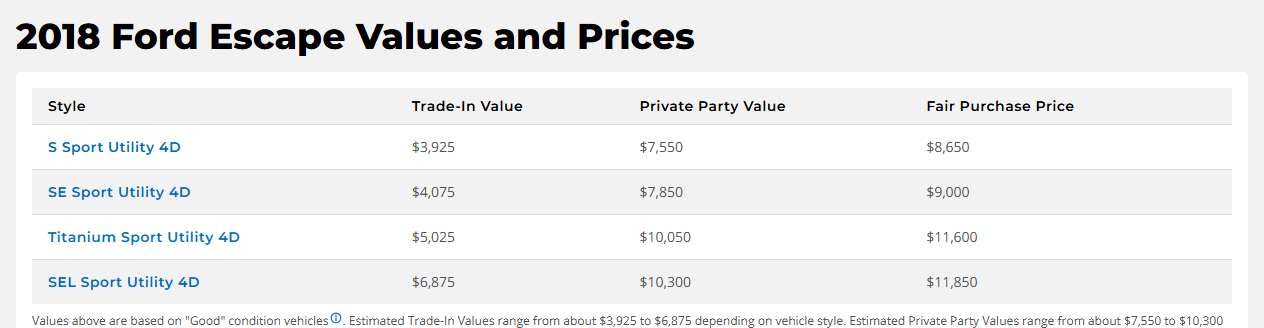
For the SE and the Titanium in every year, here is what a private sale would leave after paying a dealer $6,083 to $9,482 for the engine:
| Year, good condition | SE value | SE after the engine | Titanium value | Titanium after the engine |
|---|---|---|---|---|
| 2013 | $5,200 | $883 to $4,282 short | $6,100 | Between $17 left and $3,382 short |
| 2014 | $5,325 | $758 to $4,157 short | $6,225 | Between $142 left and $3,257 short |
| 2015 | $5,300 | $783 to $4,182 short | $6,650 | Between $567 left and $2,832 short |
| 2016 | $6,050 | $33 to $3,432 short | $8,725 | Between $2,642 left and $757 short |
| 2017 | $7,550 | Between $1,467 left and $1,932 short | $8,675 | Between $2,592 left and $807 short |
| 2018 | $7,850 | Between $1,767 left and $1,632 short | $10,050 | $568 to $3,967 left |
| 2019 | $9,750 | $268 to $3,667 left | $12,050 | $2,568 to $5,967 left |
A 2013 to 2016 SE comes out short in every city, and a 2013 to 2015 Titanium leaves at most a few hundred dollars. Only the 2018 Titanium and the 2019 SE and Titanium leave money everywhere.
Even a 2019 SE keeps just $268 at a Las Vegas price, less than buyers offered for the 2014 we quoted with a failed engine, so there selling as it is still wins. For an SEL or an S, put its own value from Kelley Blue Book in the calculator.
| Route, 2018 SE | What it costs you | After a $7,850 sale |
|---|---|---|
| Short block under program 21N12, if still covered | Nothing | $7,850, its full value |
| Dealer engine, Charlotte to Las Vegas | $6,083 to $9,482 | Between $1,767 left and $1,632 short |
| At the quotes owners reported, middle half | $8,000 to $11,000 | $150 to $3,150 short |
| Sell it as it is | None | Your best offer |
For a 2018 SE, Charlotte’s dealer price leaves $1,299 to $1,767 after a private sale, more than buyers offered for the 2014 we quoted with a failed engine. Detroit’s leaves $816 to $1,318, about the same as that offer.
At a Las Vegas price, or at a typical owner’s quote, the sale doesn’t even cover the engine.
Run Your Escape’s Numbers
The example is a 2017 SE at Detroit’s highest dealer estimate and its private-sale value, set against the best offer for the 2014, the one car we quoted whose engine alone had failed. Change all three to your own car’s figures.
No offer yet? Sell Car Advisor’s comparison tool gets you several instant offers at once.
When Is Paying for the Engine the Right Call?
A new engine makes most sense when:
- You’ll keep the car for years, and the repair costs well under what another Escape of its year would cost you to buy, roughly its private-sale value
- It’s a 2018 Titanium, an SEL or a 2019 SE or Titanium, worth well above the quote
- The quote sits near the bottom of your city’s range and the rest of the car is sound
Selling as it is wins when the quote tops the car’s running value, when it has other faults, or when you’d sell to an instant buyer anyway, since what they add for an Escape that runs is far less than an engine costs.
What Do Instant Buyers Offer for an Escape, Running or Not?
We pulled five Escapes from My Garage, Sell Car Advisor’s offer comparison form: two with failed engines and three that drove, each in the condition its owner gave.
| Escape | Miles | As the owner described it | Best offer | Second offer |
|---|---|---|---|---|
| 2014 Ford Escape | 100,000 | Engine not working, won’t start | $955 | $303 |
| 2017 Ford Escape SE | 115,000 | Engine and transmission not working, won’t start, title not in hand | $682 | $220 |
| 2017 Ford Escape SE | 94,000 | Drives, minor accident reported | $2,794 | $1,422 |
| 2018 Ford Escape | 80,000 | Drives, warning light on | $2,392 | $2,100 |
| 2017 Ford Escape Titanium | 150,000 | Drives, accident reported | $1,570 | $1,374 |
Buyers offered more for the running Escapes, but nowhere near the price of an engine. Each best offer sat below Kelley Blue Book’s trade-in value for its year at typical mileage, and no running Escape’s best offer beat a failed one’s by as much as the cheapest dealer engine costs.
So a new engine pays you back only if you keep the car or sell it privately. Fixed and sold to an instant buyer, an Escape like these returns a fraction of what the engine cost.
Counting only Escapes from these years that were 10 or more years old when quoted, so 2016 or older, the typical offer in our offer data is $933, across cars in every condition, running or not. A single car can land well above or below it.
How Do You Sell an Escape That’s Leaking Coolant Into the Engine?
The offer form asks whether the car drives, starts but won’t drive, or won’t start, and whether a warning light is on. Answer for the car today, since pickup is arranged around that answer, and an offer for a car said to drive drops when the driver finds it won’t.
A private buyer takes on the repair, so expect well under Kelley Blue Book’s trade-in value for a working Escape, and say in the listing which engine it has and what the leak has done.
The instant-offer buyers we quoted pay at pickup, when you sign the title over, so find it and check that it’s in your name before that day. Your state decides whether the plates leave with the car.
Get a number for your Escape before you pay a shop. Sell Car Advisor’s comparison tool puts one description of your car in front of several buyers, and the best offer is the number a new engine has to beat.

Article Update History
Originally posted and shared with our readers.

Sources
Ford's dealer letter of June 9, 2022, filed with NHTSA: a one-time short block repair for 7 years or 84,000 miles from the warranty start date, transferable, title-branded vehicles eligible; Escapes built September 17, 2015 through April 8, 2019; 19B37 first; the trouble codes, pressure test and borescope; 19.7 (FWD) and 21.2 (AWD) labor hours; the refund offer and the grace period ended November 30, 2022. Accessed October 13, 2026.
The new calibration runs the external coolant pump for a time after the engine is shut off, to reduce coolant intrusion into the cylinders. Filed with NHTSA. Accessed October 13, 2026.
Ford Technical Service Bulletin 22-2229: 2.0L EcoBoost coolant intrusion
NHTSA bulletin 10214126, June 2022: some 2015 to 2018 Edge and 2017 to 2019 Fusion, MKZ, Escape and MKC with the 2.0L may show low coolant, white exhaust smoke or rough running from coolant intrusion into a cylinder; the repair is a long block replacement. Summary as NHTSA lists it. Accessed October 13, 2026.
NHTSA recall 26V-011 (Ford 26S01): engine block heater, 2.0L Escape, Focus and MKC
Certain 2013 to 2019 Escapes with the 2.0L: the block heater may crack, leak coolant and short circuit when plugged in; dealers replace it free; owners told not to plug it in until it is done. Accessed October 13, 2026.
NHTSA recall 12V-551: coolant leaks and overheating, 2013 Escape 1.6L
Coolant system leaks may cause overheating and a fire; dealers inspect for leaks and reprogram the engine and cluster software with an overheat strategy. Accessed October 13, 2026.
NHTSA recall 13V-583: cylinder head overheating, 2013 Escape 1.6L
Localized overheating may crack the cylinder head and leak oil; dealers modify the engine shielding, cooling and control systems. Accessed October 13, 2026.
NHTSA recall 17V-209: coolant level sensor, 2014 Escape 1.6L
Driven low on coolant, the cylinder head may overheat, crack and leak oil; dealers install a coolant level sensor and software. Accessed October 13, 2026.
Miller v. Ford Motor Co., No. 2:20-cv-01796 (E.D. Cal.)
The consolidated class action over coolant intrusion in EcoBoost engines; still open, with class certification motions being briefed. Accessed October 13, 2026.
CarComplaints: Ford EcoBoost class action alleges faulty seals allow coolant to leak into the engine
The consolidated complaint covers 2013 to 2019 Escapes with the 1.5L, 1.6L or 2.0L EcoBoost, among other models. Accessed October 13, 2026.
FuelEconomy.gov: 2013 to 2019 Ford Escape engines
The EPA's listings by year: 1.6L turbo, 2.0L turbo and 2.5L for 2013 to 2016; 1.5L turbo, 2.0L turbo and 2.5L for 2017 to 2019. Accessed October 13, 2026.
NHTSA: vehicle complaints, 2013 to 2019 Ford Escape
The 6,645 complaints filed under engine for the seven model years, read from NHTSA's complaints API and grouped by model year; the engine prices owners reported in the 2017 to 2019 complaints that describe coolant loss. Accessed October 13, 2026.
Kelley Blue Book: Ford Escape engine replacement pricing
Dealer estimates, parts and labor, for a 2018 and a 2014 in ZIP 28202, 48226 and 89101: $6,083 to $9,482, of which labor $2,426 to $3,793, the same for both years. Accessed October 13, 2026.
Kelley Blue Book: 2018 Ford Escape engine diagnostics
Dealer estimate for ZIP 28202, 48226 and 89101: $232 to $327. Accessed October 13, 2026.
Kelley Blue Book: 2013 to 2019 Ford Escape values
Trade-in and private party values by trim, good condition, typical mileage, from each year's page. Accessed October 13, 2026.
Sell Car Advisor: My Garage instant offers
Instant offers from several buyers on the same car, with the condition the owner gave, quoted March to October 2026. These are the cars in this page's offer tables and the set behind the condition figures (how much less buyers offer for a car that doesn't start or doesn't drive), compared within groups of cars of similar age and mileage. The model-year charts come from a larger set of offers going back to 2021.
Junk Car Value Statistics, Sell Car Advisor
"On this page: 1 figure from 17,628 instant cash offers" Accessed Oct. 17, 2026
Found this useful? Show Sell Car Advisor first when you search on Google.
Add us as a preferred source on Google