

SellCarAdvisor is reader-supported, when you sign up through links on this post, we may receive compensation at no extra cost to you. How We Work.
The bottom line: A bill of sale for a car is a legal document that records the sale and protects both buyer and seller. Think of it as a receipt and a basic contract combined into one.
It’s not the same as a title. The title transfers legal ownership. The bill of sale proves the transaction happened. You need both. Ready to sell? Compare offers from multiple buyers before you sign anything.
Key Takeaways
- Sign the bill of sale before handing over the keys or title. Once the buyer has both, they have little reason to sign anything.
- The bill of sale must include the VIN, sale price, date, and both signatures to be legally useful.
- A bill of sale alone won’t protect you from post-sale liability. You also need to follow your state’s title transfer or release of liability process.
- Only 5 states require a notarized bill of sale, and each has specific conditions attached.
- A handwritten bill of sale is legally valid as long as it includes all required information and both signatures.
Compare Instant Offers





What is a Bill of Sale for a Car?
Think of a bill of sale as your car transaction’s official receipt, but with more legal muscle. It’s a document that proves you sold your vehicle and transferred ownership to someone else.
Unlike a simple receipt you’d get at a store, a bill of sale serves dual purposes: it’s both proof of purchase and a basic contract between you and the buyer.
Here’s what makes it different from other car paperwork: while your car’s title proves legal ownership, the bill of sale documents the actual transaction.
You need both pieces working together. The bill of sale shows the sale happened, and the signed title officially transfers ownership.
The document creates a paper trail that protects everyone involved. For you as the seller, it proves you’re no longer responsible for the vehicle. For the buyer, it establishes their right to the car and provides details about what they purchased.
Example of a Bill of Sale for Georgia State:

Why You Need a Bill of Sale When Selling Your Car
Protection from Future Headaches
Once you hand over those keys, you want to be completely done with that car. A bill of sale documents when the transaction occurred, which can help establish a timeline if disputes arise.
In most states, you’ll need to take additional steps, like filing a release of liability form, properly transferring the title, or following specific state procedures, to fully protect yourself from tickets and violations committed by someone else.
Proof the Transaction Actually Happened
People’s memories get fuzzy, and disputes happen. Maybe the buyer claims they paid a different amount, or someone tries to say the sale never occurred. Your signed bill of sale becomes your evidence that everything went down as agreed.
Legal Protection in Disputes
If disagreements end up in court, the bill of sale gets reviewed to see what terms both parties agreed to honor. It’s your official record of the deal you made.
Tax and Record-Keeping Benefits
You’ll want documentation of the sale price for tax purposes, and having organized records makes life easier if questions come up later.
When is a Bill of Sale Required?
States that Legally Require Bills of Sale
Some states require bills of sale for vehicle registration, while others use them for tax calculation purposes or recommend them as best practice.
Requirements vary by state and sometimes by situation. If you’re selling a car in any of the states below, check with your local DMV about the specific requirements that apply to your sale:
- Arkansas
- Colorado (only when the title has no space for the sale price)
- Connecticut
- Iowa (Hardin County only)
- Louisiana
- Maine
- Maryland
- Massachusetts
- Missouri (vehicles under 10 years old or under 16,000 lbs)
- Montana
- Nebraska
- Nevada
- New Hampshire
- New York
- North Dakota
- Oklahoma
- Rhode Island
- South Dakota
- Vermont
- Virginia (vehicles over 5 years old)
- Washington
- West Virginia
States that Don’t Require but Recommend
Even if your state doesn’t legally require a bill of sale, it’s still smart to have one. The extra protection costs you nothing but a few minutes of paperwork.
Sell Car Advisor Note: Even if your state doesn’t require a bill of sale, having one protects you if disputes come up later.
Notarization Requirements
Only a few states require a licensed notary public to notarize your bill of sale, and most have specific conditions attached. These states are:
- Louisiana (all private vehicle sales must be notarized)
- Nebraska (required for most private vehicle sales, primarily to claim a sales tax credit)
- Maryland (only if the vehicle is under 7 years old and is sold below book value)
- West Virginia (only when the sale price is less than 50% of the NADA Clean Loan Book value)
- Montana (only in specific situations, such as when applying for a bond or break title)
If you’re in one of these situations, both you and the buyer need to sign the document in front of a notary. The notary will verify both of your identities, watch you sign, then stamp the document with their official seal.
Most notaries charge a small fee for this service. You can find them at banks, libraries, or shipping stores like UPS or FedEx.
Learn more: What States Require Vehicle Bill of Sale to Be Notarized?
What Must Be Included in a Bill of Sale?
Essential Elements You Can’t Skip
Every bill of sale needs these core pieces of information:
- Party information: Full names, addresses, and contact information for both you and the buyer. This isn’t the place to get creative with nicknames. Use legal names exactly as they appear on your driver’s licenses.
- Vehicle details: Include the year, make, model, color, and most importantly, the Vehicle Identification Number (VIN). The VIN acts like your car’s fingerprint and is the unique identifier that prevents mix-ups.
- Transaction specifics: Write down the exact sale price, how payment was made, and the date of sale. If the buyer is paying in installments, spell out those terms clearly.
- Signatures: Both you and the buyer need to sign and date the document. In states requiring notarization, this happens in front of the notary.
Additional Information to Include
- Odometer disclosure: If your vehicle is less than 10 years old, you’ll need to include the current mileage. This helps prevent odometer fraud.
- Condition statements: Most private sales include language stating the car is sold “as-is,” meaning you’re not providing any warranties about its condition. This protects you from future complaints about problems the buyer discovers.
- Lien information: If there are any outstanding loans or liens on the vehicle, these must be disclosed. The buyer needs to know what they’re taking on.
Official Forms vs. Handwritten Bills of Sale
State-Provided DMV Forms
Many states offer official bill of sale forms you can download from their DMV websites. These forms include everything your state requires, which takes the guesswork out of the process.
These states have no official state form: Alabama, Alaska, Colorado, Delaware, Illinois, Kentucky, Massachusetts, Michigan, Minnesota, Mississippi, New Jersey, North Carolina, Ohio, Pennsylvania, South Carolina, Tennessee, Texas, Wisconsin, and Wyoming. If your state is on this list, our free bill of sale generator will create a compliant document for you.
| State | Bill of Sale Form |
|---|---|
| Arizona | Form 48-2004 |
| Arkansas | Form 10-313 |
| California | Form REG 135 |
| Connecticut | Form H-31 |
| Florida | Form HSMV 82050 |
| Georgia | Form T-7 |
| Hawaii | Form CS-L (MVR) 40 |
| Idaho | Form ITD 3738 |
| Indiana | Form 44237 |
| Iowa | State Bill of Sale Form |
| Kansas | Form TR-312 |
| Louisiana | State Bill of Sale Form |
| Maine | Motor Vehicle Bill of Sale |
| Maryland | Form VR-181 |
| Missouri | Form 1957 |
| Montana | Form MV24 |
| Nebraska | State Bill of Sale Form |
| Nevada | Form VP 104 |
| New Hampshire | DMV Bill of Sale Form |
| New Mexico | Form MVD-10009 |
| New York | Form MV-912 |
| North Dakota | Form SFN 2888 |
| Oklahoma | Form 722-1 |
| Oregon | Form 735-501 |
| Rhode Island | Form 1816 |
| South Dakota | Form 1025 |
| Utah | Form TC-843 |
| Vermont | Form VT-005 |
| Virginia | Form SUT 1 |
| Washington | Form 420-065 |
| West Virginia | Form DMV-7-TR |
Handwritten Bills of Sale
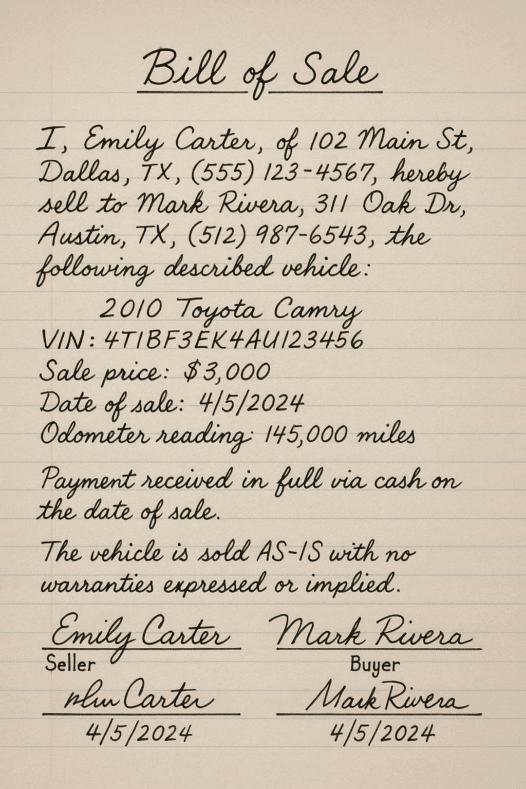
Don’t have access to a printer or official form? No problem. Handwritten bills of sale are completely legal as long as they include all the required information. You can write one on a regular piece of paper, and it carries the same legal weight as a printed form.
The key is making sure you don’t miss any essential details. Write clearly because illegible handwriting could cause problems later.
Note: We recommend using printed forms, but in exceptional circumstances, handwritten forms may be used.
Step-by-Step: How to Complete a Bill of Sale
Before the Buyer Arrives
Gather all the information you’ll need: your car’s VIN (check the dashboard or driver’s side door frame), current odometer reading, and details about any liens or special conditions.
During the Transaction
Complete the bill of sale before money changes hands and before you sign over the title. This order matters. Once you’ve handed over the keys and title, you lose most of your negotiating power if the buyer decides they don’t want to sign additional paperwork.
Fill out all the required fields carefully. Double-check the VIN because getting this wrong can cause major headaches later. Make sure both you and the buyer sign and date the document.
After Signing
Make copies for both parties. You’ll want to keep your copy permanently, as it may be needed for tax purposes or legal issues years down the road.
Common Mistakes to Avoid
1. Don’t Hand Over Keys Before Paperwork is Complete
This is the biggest mistake sellers make. Once the buyer has possession of the car and the signed title, they have little incentive to sign a bill of sale. Get all paperwork completed and signed before you hand over anything.
2. Don’t Skip the VIN Check
Writing down the wrong VIN can invalidate your bill of sale or cause registration problems for the buyer. Take the extra minute to verify this number is correct.
Read more: Is Vehicle History Report Worth for Sellers? (VIN Check)
3. Don’t Use Correction Fluid
If you make a mistake, start over with a new form. Alterations, cross-outs, or whiteout can raise questions about the document’s validity.
4. Don’t Forget to Make Copies
Both you and the buyer should have copies of the signed bill of sale. Don’t rely on the buyer to make copies for you.
What Happens After the Bill of Sale is Signed?
Title Transfer Process
The buyer will take your signed title and the bill of sale to their local DMV to register the vehicle in their name. They typically have 10 to 30 days to complete this process, depending on their state’s requirements.
Learn more: What is a Car Title? (Everything Sellers Need to Know)
Your Next Steps
Remove your license plates before the buyer leaves (in most states, plates stay with the seller, not the car). You can transfer these plates to another vehicle you own or turn them in to your DMV.
Check if your state requires or offers a release of liability form or vehicle transfer notification. This creates an official record that you sold the vehicle and helps protect you from future liability.
In many states, this additional step is more important for liability protection than the bill of sale itself.
Timeline Considerations
Don’t be surprised if you continue receiving registration renewal notices for a few weeks or months. It takes time for the new owner’s registration to process and for your name to be removed from the vehicle record.
Risks of Not Having a Bill of Sale
Ongoing Liability Exposure
Without proper documentation of your sale, you may have difficulty proving when you sold the vehicle if issues arise.
Liability protection typically depends more on following your state’s specific procedures for title transfer and any required notifications to the DMV.
Difficulty Proving the Sale Occurred
If disputes come up, maybe the buyer claims they paid a different amount or there are questions about when the sale happened. You’ll have a much harder time proving your case without proper documentation.
Problems with Insurance and Legal Issues
Insurance companies and courts prefer clear paper trails. Missing documentation can complicate claims or legal proceedings.
Learn more: When to Cancel Car Insurance After Selling a Car?
Challenges in Recovering Money Owed
If the buyer still owes you money and you don’t have a signed bill of sale, you’ll have limited legal options for collecting the balance.
Compare Instant Offers
Compare Instant Offers
Frequently Asked Questions
Can I write a bill of sale on a piece of paper?
Yes, handwritten bills of sale are legally valid as long as they include all required information and are signed by both parties. Use clear handwriting and make sure you don’t miss any essential details.
Do I need a notary for my bill of sale?
Only a handful of states require notarized bills of sale, and each has specific conditions. Louisiana requires notarization for all private vehicle sales.
Nebraska requires one for most private sales, primarily for sales tax credit purposes.
Maryland requires notarization when the car is under 7 years old and is sold below book value. West Virginia requires it when the sale price is less than 50% of the NADA Clean Loan Book value.
Montana requires it in certain situations, such as when applying for a bond title. For all other states, notarization adds extra legal protection but is not required.
What if the buyer refuses to sign a bill of sale?
You generally cannot legally force a buyer to sign. Your best option is to refuse to complete the sale without proper documentation. Don’t hand over keys or title until all paperwork is signed.
Can I get a bill of sale signed after I’ve already given the buyer the keys and title?
While possible, it’s much harder and you lose most of your leverage. The buyer has little incentive to sign once they have possession. Always complete paperwork before transferring the vehicle.
What’s the difference between a bill of sale and a title?
A title proves legal ownership, while a bill of sale documents the transaction. The bill of sale proves the sale occurred and records the terms, while the signed title transfers ownership to the new owner.
For liability protection, most states require additional steps like following specific title transfer procedures or filing a release of liability form.
How long do I have to keep my copy of the bill of sale?
Keep it permanently. You may need it for tax purposes, insurance claims, or legal disputes years later. Store it somewhere safe with your other important documents.
What if I lost my bill of sale?
Check your car’s glove box first, as many people store it there and forget. Contact your state DMV to see if they have it on file.
You can also recreate the transaction using payment records, emails, or text messages, or contact the buyer to get a copy.
Do both buyer and seller need to sign?
Yes, both parties should sign for full legal protection. Without the buyer’s signature, the document isn’t an enforceable contract, though it still has some legal value for documenting the sale date and price.

Article Update History
State bill of sale requirements and official form links updated. Notarization rules verified for all 50 states, including which states require it and under what conditions.
Originally posted and shared with our readers.