

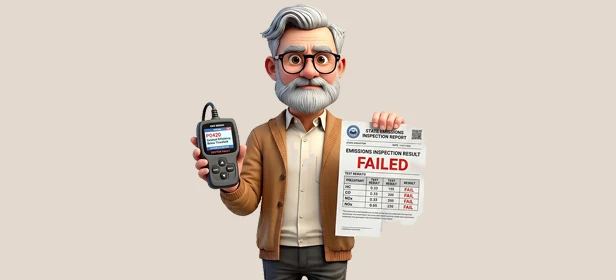
The bottom line: After a failed emissions test, you can repair the car, get an emissions waiver, or sell it as-is. Which makes sense depends on what the repair costs against what buyers offer for the car.
Most failed tests come with a warning light on, and buyers offer about 18% less for a car with one than for the same car without it.
In every state but California, Colorado, Georgia and Missouri, the buyer, not the seller, produces the passing test. In 22 states there is no emissions test at all.
Services like Peddle, Wheelzy, CarBrain, and CashForCars buy cars with failed emissions tests and pick them up for free.

What would buyers pay for your car after a failed emissions test?Fill in one form, warning lights and catalytic converter included, and see which buyers make an offer for the car as it is.
Key Takeaways
- Online junk buyers are the fastest way to sell a failed-emissions car: the four above tow it for free and no repair is needed.
- In most states you don’t need a passing emissions certificate to sell; the buyer tests at registration. The seller is responsible only in California, Colorado, Georgia and Missouri, and even there a car sold to a junk buyer or dismantler is exempt.
- If the repair estimate is more than half of what buyers offer for the car, selling as-is almost always makes more sense than fixing it first.
- You can sell a failed-emissions car privately, but you must disclose the failure in writing to protect yourself legally.
- A warning light on the dashboard, which most failed tests come with, costs a big share of the best offer, so get quotes before you spend on repairs.
- Always get quotes from multiple buyers. The same car can get different offers depending on the buyer’s local network and demand.

-
Offer amount 30% 5/5
-
Quote speed 20% 5/5
-
Pickup speed 20% 4/5
-
Vehicle acceptance 15% 5/5
-
Process ease 15% 5/5
- Buys any car in any condition, running or not
- Free towing, with no fees taken off the offer
- You can cancel before pickup at no cost
- Pays by check on the spot at pickup

-
Offer amount 30% 5/5
-
Quote speed 20% 5/5
-
Pickup speed 20% 5/5
-
Vehicle acceptance 15% 4/5
-
Process ease 15% 4/5
- Buys damaged cars, even ones that can't be driven
- The engine and transmission must still be in
- Free towing, included with every offer
- Picks up within 48 hours, sometimes the same day

-
Offer amount 30% 4.5/5
-
Quote speed 20% 5/5
-
Pickup speed 20% 4/5
-
Vehicle acceptance 15% 4/5
-
Process ease 15% 2/5
- Owned by Copart, the salvage auction company
- Buys almost any vehicle with a motor, running or not
- Free towing, and it handles the title transfer
- Hands you a check at pickup, or mails it

Automated assistant: general info, not legal advice
Answers come from our state paperwork data and published guides. Confirm anything binding with your state DMV.
Compare Instant Offers

Should You Repair or Sell As-Is?
The Half Rule: Your Starting Point
The first thing to do after a failed emissions test is get a repair estimate. That number tells you everything.
If the repair costs less than half of what buyers offer for the car, fixing it often makes sense. If it costs more, selling as-is usually puts more money in your pocket once you count what you’d spend to make the car pass.
An oxygen sensor runs $440 to $523, with parts at the manufacturer’s list price, which a newer car offered well into the thousands can justify and a car quoted as junk can’t. Use RepairPal to get a local estimate before making any decision.
What you’re likely dealing with, and what RepairPal says it costs to fix, with parts at the manufacturer’s list price:
| Repair | RepairPal national average | What it usually fixes |
|---|---|---|
| Gas cap | $138 to $150 | A loose or cracked cap sets an EVAP code |
| Engine air filter | $79 to $99 | A clogged filter richens the mixture |
| Oil change | $160 to $188 | Old oil raises hydrocarbon readings |
| Spark plugs | $288 to $399 | Misfires and a rough idle |
| Ignition coil | $238 to $320 | A misfire code on one cylinder |
| Oxygen sensor | $440 to $523 | The most common check-engine cause |
| EGR valve | $489 to $632 | High nitrogen oxide readings |
| EVAP purge valve | A shop estimate; RepairPal publishes no figure | EVAP system codes |
| Engine control module | $1,122 to $1,192 | A computer that will not report readiness |
| Catalytic converter | $2,280 to $2,480 | The big one: an efficiency code that will not clear |
What common repairs cost RepairPal national averages, 21 repairs, dated 2026-09-03Show the numbers
Repair Low estimate High estimate Transmission replacement $6,238 $6,764 Head gasket $2,572 $3,386 Timing chain $2,120 $2,764 Catalytic converter $2,280 $2,480 Clutch $1,630 $2,047 Radiator $1,368 $1,550 Fuel pump $1,344 $1,513 AC compressor $1,081 $1,463 Shock or strut $1,144 $1,348 Muffler $1,138 $1,190 Engine control module $1,122 $1,192 Timing belt $918 $1,338 Water pump $891 $1,135 Alternator $809 $1,088 Starter $565 $796 EGR valve $489 $632 Oxygen sensor $440 $523 Wheel bearing $346 $504 Brake pads $335 $394 Spark plugs $288 $399 Ignition coil $238 $320 
Older cars often run into a chain of problems. Fix the catalytic converter today, and next month it’s an oxygen sensor. A full diagnosis before committing to repairs shows the whole picture.
Your Three Main Options: A Decision Framework
Three paths, and the estimate against the offer decides between them.
Option 1: Repair Your Car
Repair makes sense when the fix is minor and the car is still offered well above it. The table tells you which category you’re in.
One situation where repair almost always wins: recalls. If your emissions failure is tied to an open recall, the manufacturer may fix it for free. Check your VIN before paying for anything.
Option 2: Get an Emissions Waiver
A waiver doesn’t fix the car. It lets the owner register it for one more cycle after spending a set amount on certified repairs, and some states offer repair help or a retirement payment instead. What the program states publish, from our 50-state paperwork data:
Selling a waived car is a different question. In California, a repair cost waiver from the Smog Check Referee postpones the certificate for a registration renewal only; a waived vehicle must be repaired before a change of ownership. Check your state’s current rules before assuming you qualify.
Option 3: Sell As-Is
For many people dealing with emissions failures, selling the car without repairs ends up being the smartest financial move. This option makes sense when the repair costs more than buyers offer for the car, or when you need to move on quickly.
Selling makes the most sense when:
- You’re dealing with a major repair like a catalytic converter
- Your car has multiple problems beyond just emissions
- You need cash quickly and don’t want to deal with repairs
- The car is older and likely to develop additional problems soon
In the four states where the seller is responsible for the test, a car sold to a dismantler or junk buyer to be wrecked is exempt. In California, no smog certificate is needed when the vehicle is sold to a licensed dismantler to be wrecked or dismantled. In Georgia, a car sold for salvage or for parts, towed away and not driven on the road, needs no passing emissions certificate; the seller notes the purpose of the sale on the bill of sale (Rule 391-3-20-.18).
Selling to a dealer in California hands the certificate to the dealer: a dealer that resells the car has to provide a Smog Check passed within the past two years, so the certificate becomes the dealer's job when you sell to one. Whatever the route, have the title in hand; a car sold without its title is a harder sale everywhere.
Best Car-Buying Services for Failed Emissions Vehicles
Online car-buying services give you a guaranteed offer and pick the car up within days, instead of weeks spent looking for a private buyer willing to take on an emissions-failed car. They usually offer less than a patient private sale would bring, but the legal risk, the repair costs and the time go with the car.
Over the last twelve months, half of all offers on cars 10 years and older fell between $355 and $1,105. Buyers offer about 18% less for a car with a warning light on than for the same car without one, across cars quoted by several buyers on the same day; the chart shows it beside the other conditions we measure.
What the condition of a car does to its best offer 1,564 cars of every age quoted by up to three buyers, compared inside matched mileage and age groupsShow the numbers
Condition Change in best offer Offers Catalytic converter missing -57% 389 Does not start -46% 916 Starts but does not drive -29% 686 Sitting at a mechanic -23% 485 Dashboard warning light on -18% 1,434 Broken glass, mirror or light -14% 867 Body damage -13% 867 Loan outstanding -5% 645 Interior damage -3% 867 Accident history 1% 1,434 
1. Peddle
Peddle buys junk, salvage, and non-running cars
- Free towing
- Fast payment
- Buys non running cars
- Pays by check at pickup
-
Offer amount 30% 5/5
-
Quote speed 20% 5/5
-
Pickup speed 20% 4/5
-
Vehicle acceptance 15% 5/5
-
Process ease 15% 5/5
Peddle is one of the most trusted names in online car buying for damaged and problem vehicles. They buy cars in any condition, including those with emissions failures, and pick them up for free nationwide.
With 4.7/5 on Trustpilot (214,087 reviews) and 4.5/5 on Google, Peddle has proven itself as a reliable option for sellers who want a fast, straightforward experience.
What sets Peddle apart:
- Up to seven days to accept the offer
- Ownership transfer included at no cost
- Established track record, with over 4.5 million cars bought by its own count
Things to consider:
- Payment is typically a company check, or cash if the towing company offers it
- Some customers report occasional delays in pickup scheduling
- Offers may be adjusted if the car’s condition doesn’t match what was described
2. Wheelzy
Wheelzy buys cars in any condition, running or not
- Buys cars without keys
- Buys cars missing parts, engine and transmission in
- Pays cash or check at pickup
- Quote often needs a phone call
-
Offer amount 30% 5/5
-
Quote speed 20% 5/5
-
Pickup speed 20% 5/5
-
Vehicle acceptance 15% 4/5
-
Process ease 15% 4/5
Wheelzy specializes in junk cars, wrecked vehicles, and cars that won’t start. They’ve earned a 4.7/5 on Trustpilot (85,842 reviews), and sellers who rate them highly mention a quick, easy sale and being kept informed.
Their process is simple: describe your car, get an offer in minutes, and schedule a free pickup at a time that suits you.
Wheelzy’s strengths:
- Responsive customer service and clear communication throughout the process
- Payment is cash or check at your door, depending on the towing company
- Your accepted offer can still drop at pickup if a part like the catalytic converter is missing or replaced, and you can say no
- Picks up within 48 hours, sometimes the same day
Things to consider:
- First offers may be lower than other buyers’, so compare before you accept
- Offers can change if you describe your vehicle inaccurately
- They don’t buy vehicles older than 1981
3. CarBrain

CarBrain specializes in wrecked and broken-down vehicles
- Pickup 24 to 48 hours after accepting
- Buys totaled and wrecked cars
- Buys cars with blown engines
- Handles bad transmission sales
-
Offer amount 30% 3/5
-
Quote speed 20% 4/5
-
Pickup speed 20% 4/5
-
Vehicle acceptance 15% 3/5
-
Process ease 15% 5/5
CarBrain specifically targets problem vehicles, including those with emissions failures. They’ve been in business since 2007, counting their DamagedCars.com years, and have made close to a million offers, giving them deep experience with vehicles that other buyers reject.
They have a 4.8/5 on Trustpilot (7,791 reviews) and a 4.9/5 on Google (6,889 reviews).
CarBrain’s advantages:
- Most cars get an instant online quote without waiting for a callback
- Quotes are valid for 7 days so you can compare other offers
- Specifically handles emissions-failed and damaged vehicles
Things to consider:
- Offers tend to run lower than some competitors, so it’s worth comparing
- They won’t buy cars missing the engine or transmission
- Expect follow-up calls and emails after submitting a quote request
4. CashForCars
CashForCars is owned by Copart and buys cars in any condition
- Free towing from nearly 200 locations
- Buys any vehicle with a motor, running or not
- Backed by Copart auction yards
- Pays a check right at pickup
-
Offer amount 30% 4.5/5
-
Quote speed 20% 5/5
-
Pickup speed 20% 4/5
-
Vehicle acceptance 15% 4/5
-
Process ease 15% 2/5
CashForCars is owned by Copart, one of the largest vehicle auction companies in the country. That backing gives them a consistent nationwide presence and the ability to buy cars in pretty much any condition, including emissions failures.
They have a 4.3/5 on Trustpilot (8,874 reviews).
CashForCars benefits:
- Quotes in about 2 minutes online or by calling (877) 748-6945
- Pickup within 24 hours in most cases, sometimes the same day
- Accepts vehicles that won’t start, have bad transmissions, or have major damage
- Free towing no matter where your car is parked
Things to consider:
- Payment is by check at pickup, and how long it takes to clear varies
- Getting a specific pickup time can be hard since trucks batch their routes
- The driver may offer less than your original quote if they find undisclosed damage
Private Sales: The Most Money, the Most Work
When Private Sales Make Sense
Selling privately can bring more than a car-buying service offers, but it takes a lot more effort and comes with disclosure duties that many people prefer to avoid.
What matters is honestly evaluating whether the extra money is worth the additional work and risk.
Private sales work best when:
- Your car has good overall value despite the emissions issue
- You’re dealing with minor emissions problems that savvy buyers might overlook
- You have the time and energy to handle questions, showings, and paperwork
- You’re comfortable handling the legal requirements for disclosing problems
Private sales become harder when:
- Your car has multiple issues beyond just emissions
- You need to sell quickly for financial reasons
- You’re uncomfortable with legal documentation and disclosure requirements
- You don’t want to deal with very low offers or time-wasters
Legal Requirements for Private Sales
Selling a car with known problems isn’t illegal, but failing to disclose those problems properly can land you in legal trouble.
The principle is the same everywhere: honesty protects you.
The documents that protect you:
| Document | What it does for you |
|---|---|
| Signed emissions disclosure | Proves the buyer was told about the failure |
| “As-is” bill of sale | Limits your liability after the sale |
| Copy of the failed test report | Shows the specific problem |
| Repair estimates | Shows you did your homework and priced for it |
| Written messages | Email or text showing the buyer knew |
Sample disclosure language: “Buyer affirms vehicle did not pass most recent emissions test on [DATE] due to [SPECIFIC REASON]. Buyer accepts vehicle AS-IS knowing repairs estimated at $[AMOUNT] are needed to bring emissions into compliance.” Put it on the bill of sale itself.
Additional protective steps:
- Take photos of the odometer reading at time of sale
- Keep copies of all documentation
- Meet buyers in public places and bring a friend if possible
- Never accept personal checks. Cashier’s checks or cash only.
Finding the Right Private Buyers
Some buyers see value in a project car or fixer-upper; aim at them.
Target these buyer types:
- Mechanics and auto technicians who can fix problems cheaply
- DIY enthusiasts looking for project vehicles
- Automotive students who need practice cars
- People buying for parts or scrap value
- Flippers who specialize in problem vehicles
Effective listing strategies:
- Be completely upfront about the emissions failure in your title and description
- Include photos of the failed test report
- List the specific problem (e.g., “needs catalytic converter”)
- Provide repair estimates to show you’ve done your homework
- Price competitively based on repair costs
Sample listing excerpt: “2018 Honda Civic, Failed Emissions (Needs Cat Converter). Great running car that failed its recent emissions test on the catalytic converter. RepairPal estimate attached. Perfect for a mechanic or someone comfortable with repairs. All maintenance records available. Selling AS-IS.”
Making Your Final Decision
Most Common Scenarios and Recommendations
The choices that tend to work best, by situation:
| Situation | Best choice | Why |
|---|---|---|
| An older car with a major emissions fault | Car-buying services | The repair rarely pays back on a car quoted as junk, and another fault is usually close behind. |
| A newer car with a minor fault | Repair, then keep or sell privately | A car offered well into the thousands justifies a sensor or a plug set, and the problem is probably isolated. |
| A car enthusiasts want | Private sale to an enthusiast | A specialty buyer values the car beyond basic transportation and may fix it as part of the plan. |
| Several problems beyond emissions | Car-buying services | Every extra fault shrinks the private buyer pool and adds to the bill. |
| Cash needed fast | Car-buying services | Speed matters more than the last dollar; Wheelzy offers same-day pickup, though it isn’t promised, and both Wheelzy and Peddle tow for free. |
Age and mileage move the offer more than the emissions fault does. A fix that pays back on a five-year-old car rarely does on a fifteen-year-old one, and the chart shows how steep that slope is.
What mileage does to the offer, at the same age 1,007 cars 10 years and older, best of up to three offers · Miles on the odometerShow the numbers
Mileage 10 to 14 years old Offers 15 to 19 years old Offers 20 years and older Offers 50k to 99k $2,147 91 $945 33 $635 39 100k to 149k $1,229 160 $635 101 $489 88 150k to 199k $1,180 104 $499 107 $440 74 200k and up $594 48 $498 74 $418 88
Three Questions to Ask Yourself
Three questions settle most cases:
- “How much is my time worth?” If you value your time highly and don’t enjoy dealing with repairs or sales processes, car-buying services make sense.
- “Can I afford to wait for the best outcome?” If you need certainty and can’t risk a repair not fixing the problem, guaranteed offers give you that; how long a car takes to sell says what waiting costs.
- “Is this car worth fighting for?” If your vehicle has sentimental value or is particularly reliable despite the emissions issue, repairs might be worth considering.
The same car gets different offers from different buyers. In our same-day comparisons of cars 10 years and older, the middle gap between the best and worst offer was $314, and the best was at least double the worst in 39% of cars. That gap is the reason to get quotes from several buyers.
The gap between best and worst offer, by car age 998 cars 10 years and older, each quoted by two or more buyers on the same day · Age of car when quoted (years)Show the numbers
Age (years) Typical gap between best and worst offer Offers 10-12 $661 236 13-14 $518 181 15-17 $244 185 18-19 $217 123 20-24 $162 185 25+ $122 88
Compare instant offers before you accept one
Compare instant offers before you accept one
Frequently Asked Questions
What happens if the car fails its smog check before the sale?
Whose problem it is depends on where the car is registered. In California, Colorado, Georgia and Missouri the seller has to produce the passing test in a private sale, so a fail before the sale means a repair, a waiver where the state grants one, or a sale to a dismantler, which needs no test.
Everywhere else the buyer tests at registration, and the failure is something you disclose, not something that blocks the sale. Update the listing the day you know: name the failure, attach the report, and price for it.
Can I sell a car that is on an emissions waiver?
A waiver is tied to the owner’s registration, not to the car, so the buyer inherits the repair it postponed, except in California, where a waived car has to be repaired before it changes hands.
Expect the offer to be barely higher than without one. The online buyers above price the car by its condition and don’t ask about the waiver; a private buyer will price in the repair.

Article Update History
Offer and condition figures now come from Sell Car Advisor quote data, repair costs from RepairPal, and every emissions rule from the state paperwork checklist in MyGarage.
Seller certificate rules in California, Georgia and Missouri and waiver spending thresholds checked against current state figures.
Originally posted and shared with our readers.

Sources
Emissions Fail: Help Available
"BAR's Consumer Assistance Program offers repair assistance of up to $1,450 for 1996-or-newer cars ($1,100 for 1976 to 1995) and a vehicle retirement payment of $1,350 to $2,000 for a car that can be driven to a BAR-contracted dismantler under its own power. Neither is available while the vehicle is undergoing a transfer of ownership" Accessed Sep. 15, 2026
Emissions Fail: Help Available
"a repair waiver after a second failed test and $715 of emissions-related repairs within six months, or an economic hardship waiver for an owner on public assistance; each covers one emissions cycle and is refused for a car that smokes or has missing or tampered emissions parts" Accessed Sep. 10, 2026
Emissions Fail: Help Available
"one free retest at the same station within 30 days; a possible non-renewable 30-day registration extension from the county tag office; a repair waiver once emissions repairs meet the yearly minimum ($1,176 for 2026 registrations)" Accessed Sep. 10, 2026
Emissions Fail: Help Available
"a free re-test after repairs, a DEQ list of Recognized Automotive Repair Shops for the Portland area, and the Clean Air Partners Program for low-income Portland-area residents whose 1996 or newer vehicle failed the OBD test and needs minor emission-control repairs" Accessed Sep. 10, 2026
Emissions Fail: Help Available
"a repair waiver after the car fails an initial inspection and a reinspection, once emissions repairs by a certified emissions repair technician reach the current repair cost limit, adjusted each year" Accessed Sep. 10, 2026
Emissions Waiver and Ownership Change
"a repair cost waiver from the Smog Check Referee postpones the certificate for a registration renewal only; a waived vehicle must be repaired before a change of ownership" Accessed Sep. 15, 2026
Emissions Exempt if Dismantled
"no smog certificate is needed when the vehicle is sold to a licensed dismantler to be wrecked or dismantled" Accessed Sep. 15, 2026
Emissions Exempt if Dismantled
"a car sold for salvage or for parts, towed away and not driven on the road, needs no passing emissions certificate; the seller notes the purpose of the sale on the bill of sale (Rule 391-3-20-.18)" Accessed Sep. 10, 2026
Emissions When Selling to a Dealer
"a dealer that resells the car has to provide a Smog Check passed within the past two years, so the certificate becomes the dealer's job when you sell to one" Accessed Sep. 15, 2026
What the condition of a car does to its best offer, Junk Car Value Statistics
"1,564 cars of every age quoted by up to three buyers, compared inside matched mileage and age groups" Accessed Oct. 16, 2026
What mileage does to the offer, at the same age, Junk Car Value Statistics
"1,007 cars 10 years and older, best of up to three offers" Accessed Oct. 16, 2026
The gap between best and worst offer, by car age, Junk Car Value Statistics
"998 cars 10 years and older, each quoted by two or more buyers on the same day" Accessed Oct. 16, 2026
Junk Car Value Statistics, Sell Car Advisor
"On this page: 3 figures from 17,628 instant cash offers, and 4 figures from same-day quotes by several buyers" Accessed Oct. 19, 2026
"$440 to $523, oxygen sensor replacement cost; $138 to $150, gas cap replacement cost; $79 to $99, engine air filter replacement cost; $160 to $188, oil change cost; $288 to $399, spark plug replacement cost; $238 to $320, ignition coil replacement cost; $489 to $632, eGR valve replacement cost; $1,122 to $1,192, engine control module (ECU) replacement cost; $2,280 to $2,480, catalytic converter replacement cost" Accessed Sep. 11, 2026
Found this useful? Show Sell Car Advisor first when you search on Google.
Add us as a preferred source on Google