


SellCarAdvisor is reader-supported, when you sign up through links on this post, we may receive compensation at no extra cost to you. How We Work.
The bottom line: Clean the car yourself if you are selling it privately. A buyer looking at it is comparing it against the three other listings they saw that week, and the clean one reads as the cared-for one.
Skip the deep clean if you are taking an instant offer. Those buyers price damage and history and build reconditioning into every offer, so a spotless interior does not change the number.
Ten steps, six outside and four inside, get professional-quality results at home in about 4 to 6 hours. Do the outside one day and the inside the next if that’s easier.
The two-bucket method and working top to bottom matter more than anything you can spend money on. Buy the supplies once and they cover several cars.
Key Takeaways
- Two buckets: one for soapy water, one for rinsing your mitt. It is the single biggest thing that prevents paint scratches.
- Top to bottom: on the inside and the outside. Starting low means grit from the wheels and lower panels ends up on areas you have already cleaned.
- Private sales: detailing matters most here. Dealers and instant offer buyers build reconditioning into the offer whatever the car looks like.
- First impression: windows, wheels and odor are what a buyer registers in the first ten seconds of a showing.
- Timing: clean 1 to 2 days before the showing, then give it a 15-minute touch-up right before the appointment.
- Engine bay: wipe it down rather than hosing it. Water in a fuse box or on a coil pack costs more than a clean engine bay adds.

Automated assistant: general info, not legal advice
Answers come from our state paperwork data and published guides. Confirm anything binding with your state DMV.
Compare Instant Offers





Should You Clean Your Car Before Selling?
It depends entirely on who is buying. For a private sale the clean is part of the price, because the person deciding is the person looking at it.
For an instant offer it is close to irrelevant, and it is worth knowing why. Nobody from those companies sees the car before the offer is made: the number comes off a form you fill in, and the inspection happens after you have accepted.
Their form asks about damage, mileage and whether it runs. It never asks how clean the car is, so a spotless one earns nothing there and a dirty one loses nothing.
A basic clean is still worth it either way, because the photos come off the same car. What a clean car is worth on a private sale is a separate question with a longer answer.
What Do Buyers Look At First?
Buyers work through a used car in a predictable order, and it is not the order you clean it in. Windows come first, because streaks and haze are visible from ten feet away and they make everything behind them look worse.
Then the wheels. Brake dust and dull tires read as a car that was never serviced, fairly or not, and they are the cheapest thing on this list to put right.
Then the smell, before anyone has touched anything. Smoke, damp and pets are the three that end showings, and they are the hardest to fix in the last hour.
After that it is the dashboard, the driver’s seat and the door jambs, in that order. Jambs are the tell: they are the one place nobody cleans for a photo, so a clean jamb says the whole car was done rather than staged.
The trunk is last and it is worth two minutes. A buyer opens it, sees your gym bag and a spare wheel under a month of grit, and quietly revises what they think of the rest.
What Do You Need to Clean Your Car?
Essential exterior cleaning supplies
- Garden hose with adjustable nozzle
- Three buckets: one for soapy water, one to rinse the mitt, one for the wheels
- Grit guards for buckets
- Microfiber wash mitts (separate ones for body and wheels)
- Microfiber drying towels
- Quality car shampoo
- Wheel and tire cleaner
- Wheel brushes (various sizes)
- Window cleaner
- Car wax
Essential interior cleaning supplies
- Vacuum with attachments
- Microfiber cloths (multiple)
- Interior surface cleaner
- Upholstery cleaner
- Glass cleaner
- Detailing brushes
- Cotton swabs
- Odor eliminator
Optional advanced supplies
- Clay bar kit
- Polishing compound
- Headlight restoration kit
- Steam cleaner for upholstery
How to Clean the Outside: Steps 1 to 6
Six steps outside, and they run to three or four hours with the drying. Doing the outside one day and the inside the next works better for most people than trying to finish in an afternoon.
Step 1: Pre-Wash Preparations
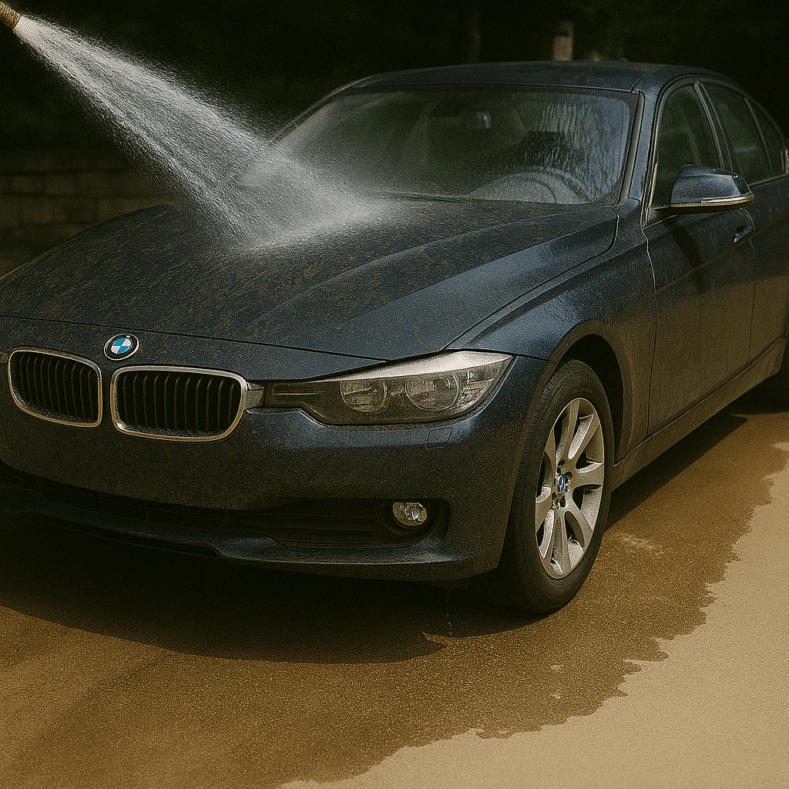
Position your car in a shaded area away from direct sunlight. This stops cleaning solutions from drying too quickly and causing streaks. Give your car a thorough initial rinse to remove loose dirt, dust, and debris.
For heavily soiled vehicles, consider a pre-wash treatment to loosen contaminants before the main wash. Options include citrus pre-wash, snow foam, or pH-neutral pre-wash. This step reduces the risk of scratching your paint during the contact wash.
Step 2: Two-Bucket Washing Method
The two-bucket method is the standard for preventing scratches while washing:
- Fill one bucket with car shampoo and water
- Fill a second bucket with clean rinse water
- Dip your microfiber wash mitt in the soapy water
- Wash from the top down, working in sections
- After each section, rinse your mitt in the clean water bucket
- Repeat the process until the entire car is washed
Thoroughly rinse the car with clean water after washing to remove all soap residue. Pay attention to crevices, trim, and around windows where soap can linger.
Step 3: Proper Drying Techniques
Dry the car immediately to prevent water spots. Use clean microfiber drying towels with long, sweeping motions or a gentle pat-drying technique.
For even better drying results that reduce direct towel contact with the paint, consider using a leaf blower to remove most of the water first.

Step 4: Applying Wax for Maximum Shine and Protection
Applying a quality car wax gives your car a high-gloss shine and adds protection. Different wax types offer varying benefits:
| Wax Type | Gloss Level | Durability | Ease of Application | Best for |
|---|---|---|---|---|
| Carnauba | High | Low to Medium | Medium to Hard | A deep shine for the photos |
| Synthetic | High | Medium to High | Easy to Medium | One coat that lasts the whole listing |
| Hybrid | High | Medium to High | Easy to Medium | Shine and durability without choosing |
| Ceramic | Very High | High | Medium | A car you will keep a while longer |
Apply wax to a cool, clean, completely dry car in a shaded area. Use a clean foam applicator pad and apply a thin, even coat in circular or overlapping motions, working one panel at a time.
Allow the wax to haze according to manufacturer instructions, then buff off with a clean microfiber towel.

Step 5: Wheel and Tire Detailing
Dirty wheels and tires can hurt your car’s appearance a lot. For proper cleaning:
- Rinse wheels thoroughly with a hose
- Apply wheel cleaner suitable for your wheel type (alloy, chrome, painted)
- Use wheel brushes to reach all areas, including inside barrels
- Rinse thoroughly to remove all cleaner and brake dust
- Clean tires with dedicated tire cleaner and stiff brush
- Apply tire shine product evenly using an applicator pad
- Wipe off excess product for a less glossy finish or to prevent sling
Clean, shiny wheels and tires make a big positive impact on a buyer’s first impression.

Step 6: Window and Mirror Cleaning
Clean, streak-free windows and mirrors improve both appearance and safety. Use an ammonia-free glass cleaner, especially for tinted windows.
Apply the cleaner either directly to the glass or onto a microfiber towel, then buff dry with a clean microfiber towel.
Tip: Wipe exterior windows using vertical motions and interior windows using horizontal motions. This makes it easy to tell whether any streaks are on the inside or outside.

How to Clean the Inside: Steps 7 to 10
Step 7: Decluttering and Thorough Vacuuming
Start your interior cleaning by completely decluttering the car:
- Remove all personal belongings and trash
- Empty storage compartments, glovebox, trunk, and door pockets
- Take out floor mats for separate cleaning
Once everything is removed, vacuum thoroughly:
- Start from the top (headliner) and work down
- Use crevice tool for tight spots between seats and console
- Use upholstery brush attachment for seats and carpets
- Move seats fully forward and back to reach all areas
- Use compressed air for stubborn dust in vents and crevices

Step 8: Interior and Carpet Cleaning
Different upholstery materials require different cleaning approaches:
Fabric upholstery
- Blot dry from outside in to prevent spreading
- Consider steam cleaning for deep stains
- Pre-treat stains with upholstery cleaner
- Clean with mild soap solution or specialized cleaner
- Gently scrub with soft-bristled brush
Leather upholstery
- Buff dry with clean cloth
- Apply leather conditioner to prevent cracking
- Dust with microfiber cloth
- Apply pH-balanced leather cleaner
Vinyl upholstery
- Use soft brush for textured areas
- Apply vinyl protectant after cleaning
- Wipe with damp cloth
- Use vinyl-specific cleaner
Step 9: Dashboard and Hard Surface Detailing
For a truly polished look:
- Dust all surfaces with microfiber cloth
- Use detailing brush for vents and crevices
- Apply appropriate cleaner for each surface type
- Clean cupholders and storage areas thoroughly
- Wipe down door panels and armrests
- Clean steering wheel and gear shift
- Use cotton swabs for intricate areas and buttons
- Apply plastic protectant to restore color and shine

Step 10: Odor Elimination
A fresh-smelling interior is important for test drives:
- Remove odor sources (food, spills, etc.)
- Air out the car by opening windows on a sunny day
- Sprinkle baking soda on carpets and upholstery, let sit overnight, then vacuum
- Clean hard surfaces with vinegar solution (1 part vinegar to 1 part water)
- Replace cabin air filter
- Use activated charcoal or coffee grounds as natural odor absorbers
- Consider commercial odor eliminators for persistent issues

The Last Hour Before a Showing
These are the jobs that only count on the day, so leave them until the showing is booked:
- Wipe the engine bay with degreaser and a cloth on a cool engine, rather than hosing it
- Clean door jambs, trunk, and hood hinges
- Organize and clean glovebox with owner’s manual visible
- Apply touch-up paint to minor chips if needed
- Check that every bulb is working
Do the full clean 1 to 2 days before the showing rather than that morning. Then give it fifteen minutes before the buyer arrives: glass, a wipe of the dash, and the floor mats out and back.
Between the clean and the showing, keep it off dirt roads and out of bad weather. Park it in shade if you can, because a hot panel dries water spots onto the paint while you wait.
Take the photos while it is at its best, on the same day you finish. The angles and the light matter as much as the clean does.

Compare Instant Offers
Compare Instant Offers
FAQ: Car Cleaning Before Selling
Can you clean a car at home without a driveway or a hose?
Yes, and most of the ten steps do not need running water. A rinseless wash does the paint in a parking space: one bucket, a capful of solution, and a fresh side of the towel for each panel.
Take the wheels and the underside to a coin-op bay, where five minutes of pressure does what a hose at home would take twenty to do badly. The whole interior half of this guide needs nothing but a vacuum and cloths.
The one thing to avoid is washing a dirty car with a dry cloth. That is where swirl marks come from, and they show up in photographs long before they show up in your driveway.
Should you clean the engine bay before selling a car?
Wipe it, do not hose it. A degreaser and a cloth on a cool engine takes twenty minutes and carries no risk; water under pressure finds fuse boxes, coil packs and sensor connectors, and a car that will not start on the morning of the showing costs you far more than a dusty engine bay ever did.
Cover the alternator and the air intake if you use any water at all, and let it dry fully before you turn the key.
There is a limit worth knowing. A spotless engine bay on a ten-year-old car makes some buyers assume you were washing away evidence of a leak, so clean rather than detailed is the target.
Does an automatic car wash count, or do you have to wash it by hand?
A touchless automatic wash is fine for the part of the job that is just dirt, and on a car you are selling next week it is a reasonable use of ten minutes.
What to avoid is the brush washes. The brushes carry grit from the car in front of you, and on dark paint the fine scratches they leave catch the light in exactly the way a photograph exaggerates.
No automatic wash does the jambs, the trunk, the wheels properly or anything inside the car, which is most of what a buyer actually looks at.

Article Update History
The page now covers what buyers look at first and what to do in the last hour before a showing.
Cleaning steps, supply lists and the order of work checked.
Originally posted and shared with our readers.
