I want to take the guesswork out of selling your car. I analyze market data, decode DMV title laws, and test out online car buyers to give you a straight answer on whether it's worth holding out for a higher price or if you're better off taking the most convenient offer and moving on.
Published:May 2, 2025
Last Updated:May 28, 2026
✓ Fact Checked:Mar 8, 2026
How is this page verified?
Information on this article is compiled from publicly available data, customer feedback and our internal analysis. All our articles are being constantly updated and fact-checked annually to ensure accuracy, timeliness, and relevance.
The bottom line: Free car valuation tools like Kelley Blue Book, Edmunds, and J.D. Power are the most widely used starting points for understanding what your car is worth. Each uses different data sources, so the numbers they give you can vary by a few thousand dollars for the same car.
Edmunds’ True Market Value is based on actual completed sales, making it closer to what buyers will really offer. KBB shows the widest range of values, including private party, trade-in, and dealer retail. J.D. Power tends to show the most conservative numbers and is the standard tool used by lenders and insurance companies.
The fastest way to find a real floor price is to get an actual instant offer from an online buyer. Free tools give you estimates, but a real offer from a buyer is the number they’ll actually pay for your specific car.
These tools work well for mainstream cars with standard mileage and condition. They’re less reliable for classic cars, vehicles with salvage titles, or heavily modified vehicles, which may need professional appraisals to get an accurate value.
Before you decide where to sell, compare offers from multiple services with Sell Car Advisor to see exactly where real offers land against what the tools told you.
Key Takeaways
private party values are typically the highest estimate, but real offers from buyers often come in below that number.
TMV and J.D. Power tend to show lower values that align more closely with actual buyer offers.
Instant cash offer platforms give you a real purchase offer, not just an estimate, making them a reliable floor price.
Values from the three major tools can differ by $3,000 to $5,000 for the exact same car.
Free tools are less reliable for cars over 20 years old, heavily modified vehicles, and salvage-title cars.
Using three or more tools together gives you a realistic value range rather than one number you may not be able to achieve.
Expert AdvisorAsk me anything about selling your car
Try asking
Automated assistant — general info, not legal advice
Answers come from our state paperwork data and published guides. Confirm anything binding with your state DMV.
Whether you’re selling your car, trading it in, or just curious about its worth, knowing your vehicle’s value gives you the upper hand in negotiations. You don’t need to pay for this information. Free tools can provide reliable estimates for most vehicles.
These valuation tools analyze factors like your car’s make, model, year, mileage, condition, and local market data to generate value ranges. Each has its own method, which is why using multiple sources gives you the most complete picture.
Here are the five best free car valuation tools that can help you understand what your car is really worth.
Kelley Blue Book has been a key resource for car valuations since 1926, starting as a physical reference guide for dealerships before becoming today’s digital platform. Their database covers nearly every make and model on the road.
How it works: Enter your vehicle details including make, model, year, mileage, condition, and features. KBB’s system pulls from wholesale auction data, dealership sales, and private transactions to provide several values based on your selling scenario:
Trade-in value (what dealers might offer)
Private party value (for direct consumer sales)
Dealer retail value (what you’d pay at a dealership)
What We Like
Large database covering nearly every vehicle
Multiple value types for different selling scenarios
Easy to use interface
Widely recognized by dealers and private buyers
Updated weekly to reflect market changes
What You Should Know
May show higher values than what buyers actually offer in some regions
Doesn’t always account for local market conditions
Can lag behind rapid market changes
Less reliable for unique, modified, or enthusiast vehicles
Best for: Mainstream vehicles with standard features and options.
Edmunds approaches valuation differently by focusing on actual sales data rather than asking prices. Founded in 1966 as Edmunds Publications, the company introduced its True Market Value service in 2000.
How it works: Input your vehicle’s details or VIN, and Edmunds calculates a True Market Value based on what similar cars actually sold for in your area. Edmunds gathers transaction data from dealerships and other sources across the country to generate its estimates.
What We Like
Based on actual transaction data, not listing prices
Considers your specific geographic location
VIN and license plate lookup for added accuracy
No personal information required to get a value
Clean, straightforward interface
What You Should Know
Less thorough for older vehicles (pre-2000)
Fewer value types than KBB
Actual transaction prices can still vary from TMV estimates
Best for: Recent model cars and getting region-specific valuations.
J.D. Power has been providing vehicle valuation data to the auto industry since the mid-1930s, with a focus on helping dealers, lenders, and insurers set fair prices. The NADA Used Car Guide transitioned to the J.D. Power brand in 2021.
How it works: Enter your vehicle details to receive values based on regional sales data and market analysis. J.D. Power primarily draws data from actual dealership transactions, incorporating both retail market prices and local demand.
What We Like
Covers a wide range of vehicles including cars, motorcycles, and RVs
Provides detailed market reports
Used by banks, credit unions, and insurance companies for loan values and appraisals
Considered the industry standard by many dealers
What You Should Know
Interface isn’t as easy to use as competitors
Limited condition categories compared to KBB
National estimates may not capture local market differences
Best for: Specialty vehicles and establishing financing values.
Lets you compare your car visually with similar vehicles
Shows actual selling trends in your area
What You Should Know
Time-consuming to research thoroughly
Requires manual analysis and averaging
Listed prices are often higher than actual selling prices
Quality of listings varies a lot
Best for: Unique or modified vehicles and highly localized markets.
5. Instant Cash Offer Platforms
Several services offer immediate purchase offers online, giving you a real-world valuation backed by an actual buying commitment.
How it works: Enter your vehicle details on sites like Carvana, CarMax, or Peddle to receive a first offer. These platforms use algorithms that analyze your car’s year, make, model, mileage, features, condition, accident history, and market conditions to generate offers.
Carvana and CarMax work best for newer cars in good condition. Peddle is a strong option for older vehicles, high-mileage cars, or cars with problems.
What We Like
Provides actual purchase offers, not just estimates
Convenient and fast process
No haggling required
Establishes a guaranteed minimum value
Multiple services can be compared
What You Should Know
Offers are typically below private party value
Condition deductions can affect the final offer after inspection
Final offers may depend on a physical inspection
Best for: Establishing a real floor price and understanding quick-sale options.
Beyond the five tools covered above, several other free resources can give you a useful additional perspective.
CarGurus – Analyzes millions of listings to provide estimates and deal ratings based on your local market
Carfax – Factors in vehicle history, including accidents and service records, to adjust values
Consumer Reports – Offers valuations based on its own research and owner satisfaction data
How to Get the Most Accurate Valuation?
For the most accurate picture of your car’s worth, combine several approaches:
Use multiple tools: Cross-reference results from 3 to 5 different valuation services, including KBB, Edmunds, J.D. Power, CarGurus, and Carfax (which considers vehicle history).
Be honest about condition: Overstating your car’s condition leads to disappointment when actual offers arrive. Most buyers and services will thoroughly inspect your vehicle before finalizing a price.
Consider your market: Values vary by region. Used cars tend to be more affordable in the Northeast and Midwest compared to Western states. Local demand for specific vehicles also affects pricing.
Factor in seasonality: Spring and early summer are peak car-buying seasons, often pushing values higher. Convertibles and sports cars tend to command more in warmer months, while SUVs and 4WD vehicles may fetch more in fall and winter in colder regions. Our guide on the best time to sell a car covers this in detail.
Account for unique factors: Rare options, low production numbers, desirable color combinations, or documented maintenance history might push value above standard estimates.
Check local listings: Look at active for-sale listings in your area to see real-world asking prices for cars like yours.
Consider depreciation trends: Some vehicles lose value faster than others. Research your specific make and model’s typical depreciation curve before deciding when to sell.
Case Study: Valuing a 2018 Honda Accord EX-L
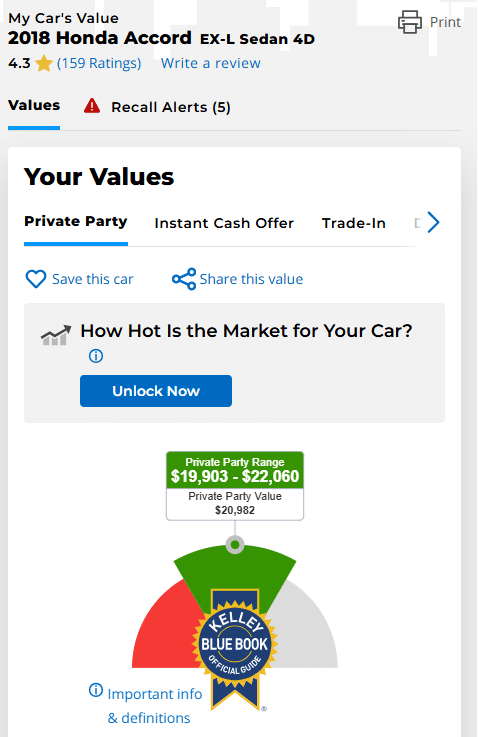
Here’s how these valuation methods apply to a real example: a 2018 Honda Accord EX-L sedan with 62,000 miles in excellent condition located in New York.
Step 1: Basic Valuation Tools Starting with the three major free tools:
Kelley Blue Book: $20,982 (private party value)
Edmunds TMV: $17,095 (trade-in value)
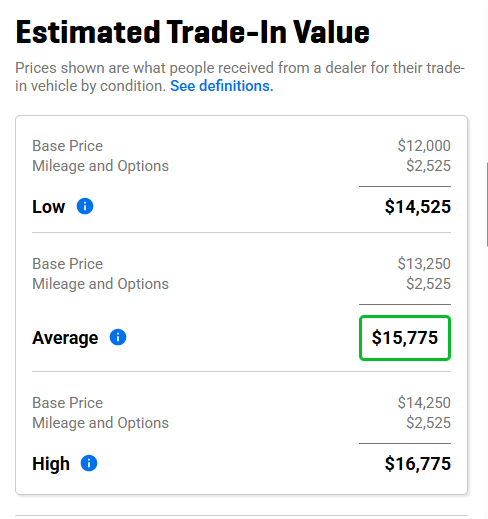
J.D. Power: $15,775 (average trade-in value)
The range between the lowest and highest estimates is $5,207, which is approximately 25% of the car’s value. That’s a big gap for the same vehicle with the same specs.
Step 2: Market Research A search of local listings within 50 miles shows:
Similar Accords listed between $19,500 to $21,900
Average asking price of $20,440
Most listings active for 2 to 3 weeks
Dealerships asking $22,194 to $24,618 for comparable models
This market research shows private party values fall between dealer trade-in offers and retail asking prices, which is typical.
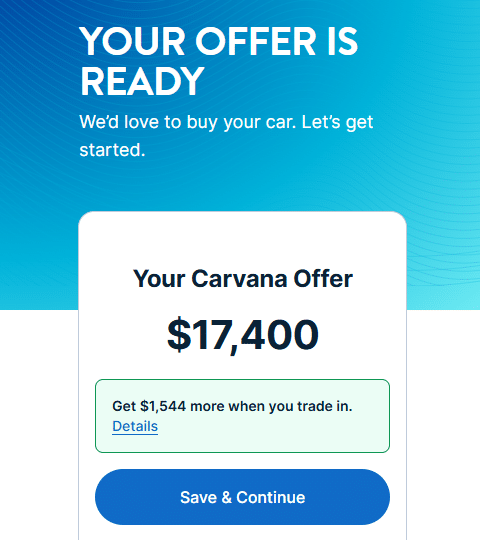
Local Honda dealer: $18,350 (with a potential trade-in bonus of $1,629)
These offers establish a real floor price. The highest instant offer ($18,350) came in at about 87% of KBB’s private party value, which is a typical ratio in the current market.
Step 4: Considering Timing and Location
The vehicle’s location in New York, with its dense population and public transportation options, affects its value differently than in rural areas with limited transit.
Selling during spring car-buying season can push values higher, since buyer demand tends to increase after tax refunds arrive and weather improves.
Step 5: Final Valuation Range
Based on all data points, here is a complete valuation range for this car:
Floor price: $16,120 (lowest instant cash offer)
Ceiling price: $20,982 (highest private party estimate)
Reasonable listing price: $20,500 to $21,500 (based on comparable active listings)
Expected selling price: $19,500 to $20,000 (after negotiation)
The difference between the highest dealer offer ($18,350) and KBB’s private party value ($20,982) shows the potential benefit of selling privately versus trading in. In this case, that gap is approximately $2,600.
This example shows why cross-referencing multiple methods gives you a more realistic picture than relying on just one estimate, especially when several thousand dollars may be at stake.
When Free Tools Aren’t Enough?
Free valuation tools work well for most everyday cars. But some vehicles need a professional appraisal to get an accurate number:
Classic cars (generally 25 or more years old)
Rare or exotic vehicles
Heavily modified cars
Vehicles with historical significance
Insurance claims (total loss or lower value disputes)
Charitable donations exceeding certain IRS thresholds
Pre-purchase inspections for valuable used cars
Financing situations where lenders require documentation
Professional appraisers provide thorough, unbiased, and legally defensible valuations. They inspect vehicles in detail, document condition with photos, and evaluate characteristics that automated tools miss.
A professional appraisal typically costs $100 to $600 depending on the vehicle type and the level of detail required. For valuable or unusual vehicles, that cost is often worth it many times over.
Free Car Valuation Tools: Frequently Asked Questions
Which free car valuation tool is the most accurate?
None of them is always the most accurate, because each tool measures something slightly different.
Edmunds TMV is based on actual completed transactions, making it closest to what buyers will realistically offer.
KBB often shows higher private party values that can be harder to achieve in practice. J.D. Power tends to run the most conservative and is what lenders use.
For the best result, use all three and treat the range, not any single number, as your working estimate.
Why do KBB, Edmunds, and J.D. Power give different values for the same car?
Each tool uses a different data source and method. KBB pulls from wholesale auctions, dealership sales, and private transactions.
Edmunds focuses on actual completed sale prices. J.D. Power draws primarily from dealership transaction data.
They also weight condition categories differently. A “good condition” car in KBB’s formula may not match what Edmunds calls “good condition.”
These differences alone can account for $1,000 to $3,000 in gap between tools.
Why do KBB, Edmunds, and J.D. Power give different values for the same car?
Each tool uses a different data source and method. KBB pulls from wholesale auctions, dealership sales, and private transactions.
Edmunds focuses on actual completed sale prices. J.D. Power draws primarily from dealership transaction data.
They also weight condition categories differently. A “good condition” car in KBB’s formula may not match what Edmunds calls “good condition.”
These differences alone can account for $1,000 to $3,000 in gap between tools.
Do free valuation tools work for cars with salvage titles or accident history?
Standard free tools like KBB and Edmunds are less reliable for cars with salvage or rebuilt titles.
They typically apply general condition deductions rather than accounting for the full market impact of a branded title.
Carfax’s valuation tool factors in accident history and may give a more realistic number for these vehicles.
Getting an actual instant offer from an online buyer will give you the most accurate floor price for a car with title or history issues.
How do I use free valuation tools when negotiating a trade-in?
Print or screenshot your KBB trade-in range and bring it with you. Dealers use their own pricing tools, and what they offer may be lower than KBB.
Knowing your range lets you push back on low offers with a specific number.
Getting an instant offer from an online buyer before visiting the dealer is even stronger. If Carvana or another buyer has offered you $17,000, that becomes your floor for the dealer negotiation.
How often are free car valuation tools updated for current market prices?
KBB updates its values weekly. Edmunds TMV refreshes based on transaction data as deals close, which can be near real-time in high-volume markets.
J.D. Power updates on a monthly basis. In a fast-moving market, even weekly updates can lag, so always check active local listings alongside these tools.
Putting It All Together
By combining these free valuation tools, you’ll build a reliable value range for your car. That knowledge gives you confidence whether you’re selling privately, trading in at a dealership, or just want to know what your car is worth before you decide anything.
Values are ultimately set by what a buyer will pay. But with data from these tools, you’ll know right away when you’re getting a fair deal and when you’re not.
Article Update History
Fact-checked
Tool descriptions, case study offer amounts, and update frequencies were reviewed. No factual changes were needed.