


The bottom line: Sell a car that burns oil before it stops starting. While it still starts and drives, it is quoted as a running car. Once it stops starting, it is offered about 46% less than the same car running.
For a newer car that still drives well with moderate consumption, check buyers like Carvana first. They factor the issue into their offer without you negotiating, and you’ll typically get more than a junk buyer offers for a car that still runs.
For an older car or severe consumption, Peddle and Wheelzy are the fastest path. Both buy problem cars in any condition and tow free, and Peddle’s tow truck typically comes within 24 to 48 hours of scheduling.
Private sales can get you the most money when consumption is moderate and the car is otherwise in good shape. They take weeks rather than days, and you have to tell buyers about the issue honestly.
Before you choose, get a mechanic’s diagnosis and compare offers from multiple services with Sell Car Advisor. The numbers will tell you what makes the most sense.

What would buyers pay for a car that burns oil?Fill in one form, warning lights included, and see which buyers make an offer for the car as it is.
Key Takeaways
- GM’s published tolerance is 1 quart per 2,000 miles and some makers allow more, but buyers don’t care about manufacturer specs. Anything worse than a quart per 2,000 miles will raise questions.
- A PCV valve replacement is $124 to $173, with parts at the manufacturer’s list price, and is the one oil-consumption fix that can pay for itself before a sale. Valve seals, rings and a head gasket cost more than they add back.
is worth checking if your car is under ten years old and still drives well, because it resells cars rather than buying them for parts and so can offer more than a junk buyer.
- Sell before it stops starting. A car that no longer starts is offered close to half less than the same car running, whatever the reason.
- Oil consumption tends to get worse over time, not better. Waiting to sell usually means getting less money.
- Offers for problem cars vary more than for clean cars. Always get at least three quotes before deciding.

-
Offer amount 30% 5/5
-
Quote speed 20% 5/5
-
Pickup speed 20% 4/5
-
Vehicle acceptance 15% 5/5
-
Process ease 15% 5/5
- Buys any car in any condition, running or not
- Free towing, with no fees taken off the offer
- You can cancel before pickup at no cost
- Pays by check on the spot at pickup

-
Offer amount 30% 5/5
-
Quote speed 20% 5/5
-
Pickup speed 20% 5/5
-
Vehicle acceptance 15% 4/5
-
Process ease 15% 4/5
- Buys damaged cars, even ones that can't be driven
- The engine and transmission must still be in
- Free towing, included with every offer
- Picks up within 48 hours, sometimes the same day

-
Offer amount 30% 4.5/5
-
Quote speed 20% 5/5
-
Pickup speed 20% 4/5
-
Vehicle acceptance 15% 4/5
-
Process ease 15% 2/5
- Owned by Copart, the salvage auction company
- Buys almost any vehicle with a motor, running or not
- Free towing, and it handles the title transfer
- Hands you a check at pickup, or mails it

Automated assistant: general info, not legal advice
Answers come from our state paperwork data and published guides. Confirm anything binding with your state DMV.
Compare Instant Offers
What Counts as High Oil Consumption?
Manufacturer Standards vs. Reality
Car companies say one thing, but buyers expect another. Most major manufacturers have published their own oil consumption tolerances. GM, for example, considers 1 quart every 2,000 miles acceptable.
Some European brands like BMW and Audi have historically allowed 1 quart every 600 to 700 miles as “normal.” Subaru has considered 1 quart per 1,000 to 1,200 miles acceptable on some of their engines.
But most cars don’t need oil added between changes. That means when you’re burning a quart every 1,000 miles, you’re well outside what most buyers expect. Buyers notice this.
When It Becomes a Problem
| Oil Consumption Rate | What It Means | Buyer Reaction |
|---|---|---|
| 1 quart per 5,000+ miles | Normal for most cars | No concerns |
| 1 quart per 2,000 to 3,000 miles | Manufacturer “acceptable” | Buyers will ask questions |
| 1 quart per 1,000 miles | High consumption | Major red flag for buyers |
| 1 quart per 500 miles | Excessive | Most buyers walk away |
If you’re adding oil once a month or more, you’ve got a problem that will lower what you’re offered.
The online buyers’ forms never ask how much oil the car uses. They ask whether it starts and drives, and Peddle counts an oil leak as a car that starts but doesn’t drive, so answer that way if yours leaks oil as well as burning it. A car that burns oil but still drives is quoted as a running car; one that no longer starts is offered about 46% less than the same car running, and a lit oil or check-engine light alone costs about 18%, across cars quoted by several buyers on the same day.
What the condition of a car does to its best offer 1,564 cars of every age quoted by up to three buyers, compared inside matched mileage and age groupsShow the numbers
Condition Change in best offer Offers Catalytic converter missing -57% 389 Does not start -46% 916 Starts but does not drive -29% 686 Sitting at a mechanic -23% 485 Dashboard warning light on -18% 1,434 Broken glass, mirror or light -14% 867 Body damage -13% 867 Loan outstanding -5% 645 Interior damage -3% 867 Accident history 1% 1,434 
How to Tell If You’re Burning vs. Leaking Oil
Burning oil happens inside the engine and shows up as blue smoke from your exhaust. Leaking oil drips on the ground and leaves spots where you park.
Check your dipstick every 500 miles for a month. Write down the dates and oil levels. This gives you hard numbers to work with when deciding how to sell.
Best Places to Sell a Car with High Oil Consumption
Use this table to find your starting point, then read the full breakdown for whichever route fits.
| Your Situation | Best Route |
|---|---|
| Less than ten years old, still drives well, moderate consumption | Try Carvana first |
| Offered well above a junk price, moderate consumption, time for a private sale | Private sale |
| Older car or severe consumption (1 qt per 500 to 1,000 miles) | Peddle or Wheelzy |
| PCV valve is the only cause, car offered well above the repair | Fix it first, then sell |
| Need money quickly, any condition | Peddle or Wheelzy |
Instant Offer Buyers (Best for Newer Cars with Moderate Consumption)
If your car is less than ten years old, still drives fine, and has a clean title, Carvana is worth checking before going straight to a junk buyer. They buy drivable cars with some mechanical issues and will factor the oil consumption into their offer automatically.
You don’t need to negotiate or explain the issue. Just enter your car’s details and you’ll get an offer in minutes. If your car qualifies, get Carvana’s offer beside Peddle’s and Wheelzy’s: it buys cars to sell on its own site, while Peddle’s buyers may resell a car, part it out or scrap it, so the three can land far apart.
This route works best when consumption is moderate (around 1 quart per 2,000 to 3,000 miles) and the car runs well otherwise. If consumption is severe or the car has other major mechanical problems, Carvana may decline or offer close to junk-car prices. In those cases, go straight to Peddle or Wheelzy.
Online Car Buyers (Easiest Option for Older or Severely Affected Cars)
Companies like Peddle and Wheelzy specialize in buying problem cars. They’ve both been in business for years and will actually buy your car with high oil consumption.
Peddle accepts cars in any condition, including ones with mechanical problems. They give you an instant quote online, pick the car up, and pay when they tow it away.
Wheelzy works similarly and offers same-day pickup in many areas. They specialize in cars with mechanical issues.
Here’s what makes them work for high oil consumption:
- They know your car has problems and price accordingly
- No long negotiations or buyer questions about the oil issue
- Free towing from your location
- You get paid at pickup
- Wheelzy handles the paperwork, and Peddle includes the ownership transfer at no cost
The downside is that a private buyer may pay more for a car with moderate consumption. But at a quart every 500 to 1,000 miles private buyers are scarce, and this is usually the realistic option.
Oil-Burning Car Quotes We Received in April 2026
For this guide, we quoted five cars that burn oil with Peddle, Wheelzy and CashForCars from one Florida ZIP code, with the oil use declared on every form, so offers where you live can be higher or lower. Peddle and CashForCars gave an online offer on all five cars, and Wheelzy gave an online offer on two and asked for a phone call on the other three.
The highest offer changed from car to car: Peddle’s on three, Wheelzy’s on the Edge and CashForCars’ on the Mustang. So quote your car with each of them before you accept an offer.
| Vehicle | | | |
|---|---|---|---|
| 2004 Nissan 350Z | $2,805 | $1,267 | Required call |
| 2009 Pontiac Vibe | $655 | $450 | Required call |
| 2008 Toyota Yaris | $560 | $506 | Required call |
| 2008 Ford Edge | $430 | $450 | $462 |
| 2005 Ford Mustang | $435 | $450 | $440 |
2004 350Z
2009 Vibe
2008 Yaris
2008 Edge
2005 Mustang
2004 Nissan 350Z Coupe
72,000 miles · burns oil

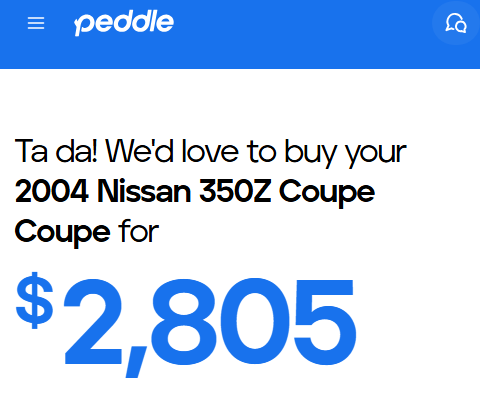


| $2,805 |
| $1,267 |
| Required call |
2009 Pontiac Vibe Base
170,896 miles · burns oil


| $655 |
| $450 |
| Required call |
2008 Toyota Yaris Hatchback
380,000 miles · burns oil

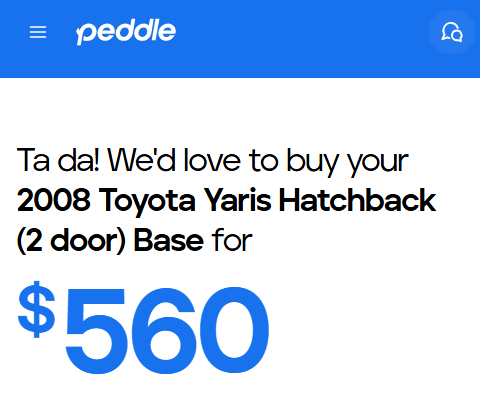


| $560 |
| $506 |
| Required call |
2008 Ford Edge SEL
226,000 miles · burns oil


| $462 |
| $450 |
| $430 |
2005 Ford Mustang Convertible
154,203 miles · burns oil


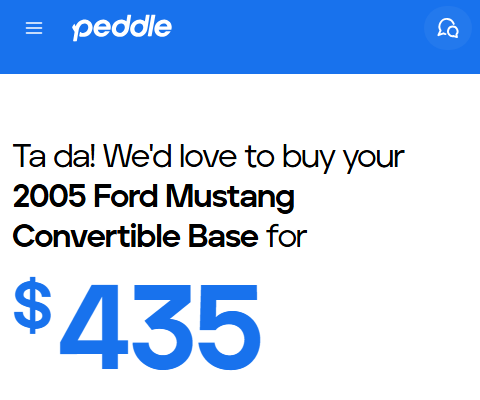
| $450 |
| $440 |
| $435 |
Private Sale (Highest Price, Most Work)
Selling privately can get you more than online buyers, but high oil consumption complicates everything.
You’ll need to price your car below similar vehicles without oil issues. Use free valuation tools like Kelley Blue Book and Edmunds to get a baseline, then adjust down based on the severity of the oil consumption.
What do you tell buyers? Answer honestly whatever they ask and put the consumption rate in writing; hiding it can be treated as misrepresentation after the sale.
Two Things Most Sellers Get Wrong
Don’t Try to Hide It with Thicker Oil or Additives
Some sellers switch to a thicker oil grade (like 10W-40 in a car that calls for 5W-20) or add a product like Lucas Oil Stabilizer before a sale. This can temporarily reduce how much oil the car burns, but it’s not a fix.
Modern engines are built to tight tolerances. Using the wrong viscosity can cause wear on parts that depend on the right oil flowing to them quickly at startup. If a buyer or their mechanic finds out, it can also be treated as misrepresentation, which creates legal exposure after the sale.
Disclose the issue honestly and price accordingly. That’s the safer approach for everyone.
Your Maintenance Records Can Make a Real Difference
If you’re selling privately and the car has a documented service history, show it. A buyer who can see that you changed the oil every 5,000 miles for the past five years knows the consumption isn’t from neglect.
This matters most with makes known for oil consumption as a design issue, like certain Toyota and Subaru models. When a buyer understands it’s a known engine trait rather than abuse, they’re more likely to buy at your asking price instead of walking away or pushing for a lower number.
How to Sell Your Car
Selling to Peddle or Wheelzy
Both services work almost identically. Here’s the process:
- Step 1: Get your quote. Go to their website, enter your car’s year, make, model, and mileage, and answer the condition questions as the car is today. You’ll get an instant offer from Peddle, while Wheelzy sends some cars to its team for review first. Peddle gives you up to seven days to accept, and Wheelzy publishes no deadline for deciding.
- Step 2: Compare offers. Get quotes from both Peddle and Wheelzy. On the same car, the gap between the best and worst same-day offer is $314 at the middle, and in 39% of cars 10 years and older the best offer was at least double the worst, in our comparison data. Then quote it with CashForCars as well, the third buyer in our quote test.
- Step 3: Accept and schedule. Once you accept, the tow company contacts you to book a pickup time.
- Step 4: Get paid. When the driver arrives, they verify the car matches your description.
The gap between best and worst offer, by car age 998 cars 10 years and older, each quoted by two or more buyers on the same day · Age of car when quoted (years)Show the numbers
Age (years) Typical gap between best and worst offer Offers 10-12 $661 236 13-14 $518 181 15-17 $244 185 18-19 $217 123 20-24 $162 185 25+ $122 88
Documents you’ll need:
- Car title (must be in your name)
- Valid photo ID
- Keys and any remotes
That’s it: quote, pickup, payment.
Selling Privately
Private sales take more work but can pay off if the oil consumption isn’t severe.
Set your price. Check what similar cars are selling for on Facebook Marketplace and Cars.com. Reduce the price based on how severe the oil consumption is.
Deduct at least the mechanic’s written estimate from the price of a comparable car without the problem, and more when the consumption is severe.
Write your listing. Take good photos in daylight. Write a detailed description that mentions all the positives, your regular maintenance history, the oil consumption issue (be specific about how much and how often), and why you’re selling.
You can use our free car ad description generator to write an ad. Being upfront about the oil consumption actually helps. It filters out buyers who won’t accept the issue and builds trust with serious buyers.
Handle inquiries and showings. When buyers ask about the oil consumption, give them the facts. Tell them how often you add oil and whether it’s gotten worse over time.
Let them take it to their mechanic for an inspection if they want.
Complete the sale. You’ll need to sign over the title and provide a bill of sale. File a release of liability with your state DMV right after the sale; sixteen states don’t have one, and everywhere else it protects you if the new owner gets tickets or has accidents before registering the car.
In California, Colorado, Georgia and Missouri the seller is responsible for the emissions test, and a car that burns oil can fail it on smoke, so check before you list.
Should You Fix the Oil Consumption First?
Before you decide to sell as-is or repair, you need exact numbers. Get a mechanic’s inspection from a shop like RepairPal to diagnose what’s causing the oil consumption and get a written repair estimate.
Get a Diagnosis First
A good mechanic can pinpoint the cause with a compression test and a leak-down test. They’ll check:
- PCV valve and system
- Valve seals and guides
- Piston rings (compression test)
- Head gasket (leak-down test)
If you already know the problem from previous diagnostics, you can skip this step and move straight to comparing repair costs versus selling as-is.
Waiting has a measured cost. When the same car was quoted again a month or more later, the offer was $40 lower at the middle and 59% of cars were offered less; a year or more on, $160 lower and 71% offered less.
What asking again later cost 109 cars 10 years and older, each quoted twice by the same buyer · Time between the two offersShow the numbers
Gap between offers Typical change in the offer Offers 1 to 3 months $0 40 3 to 6 months -$20 21 6 to 12 months -$135 17 More than a year -$160 31
Repair Costs Against the Offer
Once you know the exact repair cost, compare it to what buyers offer for the car with and without the fix; our guide on when a car isn’t worth repairing has the thresholds. RepairPal‘s national averages for the usual causes, with parts at the manufacturer’s list price:
| Problem Cause | Repair Cost | Does It Pay Back Before a Sale? |
|---|---|---|
| PCV valve | $124 to $173 | Usually. The cheapest fix, and often the whole problem. |
| Valve seals | A mechanic’s estimate | Rarely. Labor-heavy, and the buyer can’t see it was done. |
| Head gasket | $2,572 to $3,386 | Rarely. More than most older cars are offered in total. |
| Piston rings | A mechanic’s estimate (engine work) | No. Sell as-is instead. |
What common repairs cost RepairPal national averages, 21 repairs, dated 2026-09-03Show the numbers
Repair Low estimate High estimate Transmission replacement $6,238 $6,764 Head gasket $2,572 $3,386 Timing chain $2,120 $2,764 Catalytic converter $2,280 $2,480 Clutch $1,630 $2,047 Radiator $1,368 $1,550 Fuel pump $1,344 $1,513 AC compressor $1,081 $1,463 Shock or strut $1,144 $1,348 Muffler $1,138 $1,190 Engine control module $1,122 $1,192 Timing belt $918 $1,338 Water pump $891 $1,135 Alternator $809 $1,088 Starter $565 $796 EGR valve $489 $632 Oxygen sensor $440 $523 Wheel bearing $346 $504 Brake pads $335 $394 Spark plugs $288 $399 Ignition coil $238 $320 
Making Your Repair or Sell Decision
Once you have the estimate, the fix-or-sell arithmetic is the same as for any breakdown. The oil-specific points:
Repair makes sense if:
- The fix is a small fraction of what buyers offer for the car
- It’s a simple repair like a PCV valve that definitely solves the problem
- The repair is covered by warranty
- You plan to keep the car anyway
Sell as-is to Peddle or Wheelzy if:
- The repair costs more than the gap between the offer with it and without it
- The car is offered close to a junk price already
- The problem requires major engine work (rings, head gasket); our bad engine guide covers what those cars are offered
- You need money quickly and can’t wait weeks for a private sale
Sell privately as-is if:
- The car would still be offered well above a junk price
- The oil use is moderate (1 quart per 2,000 to 3,000 miles)
- You have time for a private sale
- You’re comfortable disclosing the issue and negotiating with buyers
Get quotes from at least three sources before deciding.
Compare offers from Peddle and Wheelzy, check what similar cars with oil issues are listed for on Facebook Marketplace, and consider what a local dealer might offer.
Compare instant offers before you accept one
Compare instant offers before you accept one
FAQ
Will a mechanic’s inspection scare away private buyers?
Encouraging buyers to get inspections helps. It shows you’re confident about disclosing the issue honestly.
Buyers feel more comfortable when they can verify the problem’s extent themselves. Just make sure you’ve accurately described the oil consumption in your listing.
Should I top up the oil before the buyer’s test drive or the tow truck comes?
Yes, to the full mark and no higher. A car that runs low on the test drive or on the flatbed ramp turns a running-car offer into a no-start one.
Overfilling is its own problem: it can foam the oil and smoke more, which is the one thing you don’t want a buyer to see.
Can I sell a car with high oil consumption if I still owe money on it?
Yes. The lender has to be paid off before the title can transfer, so call them for a payoff figure before you accept an offer. A loan moves the best offer less than most faults do in our data: a 5% difference against a car owned outright, matched on age and mileage.
If you owe more than buyers offer for the car, you cover the difference from your own pocket.

Article Update History
Now shows the offers online buyers made for cars that burn oil in a hand quote test, with a screenshot of each quote.
Repair cost ranges and buyer details checked against current mechanic estimates and each buyer's latest policies.
Originally posted and shared with our readers.
Sources
"Is Your Car Burning Oil? Here’s Why, Plus Ways to Fix It" Accessed Mar. 17, 2026.
"Excessive oil consumption isn't normal" Accessed Mar. 17, 2026.
"Excessive engine oil consumption" Accessed Mar. 17, 2026.
What the condition of a car does to its best offer, Junk Car Value Statistics
"1,564 cars of every age quoted by up to three buyers, compared inside matched mileage and age groups" Accessed Oct. 16, 2026
The gap between best and worst offer, by car age, Junk Car Value Statistics
"998 cars 10 years and older, each quoted by two or more buyers on the same day" Accessed Oct. 16, 2026
What asking again later cost, Junk Car Value Statistics
"109 cars 10 years and older, each quoted twice by the same buyer" Accessed Oct. 16, 2026
Junk Car Value Statistics, Sell Car Advisor
"On this page: 7 figures from 17,628 instant cash offers, and 5 figures from same-day quotes by several buyers" Accessed Oct. 19, 2026
"$124 to $173, pCV valve replacement cost; $2,572 to $3,386, head gasket replacement cost" Accessed Sep. 21, 2026
Found this useful? Show Sell Car Advisor first when you search on Google.
Add us as a preferred source on Google