

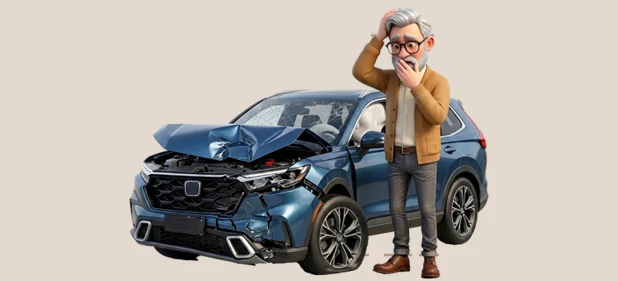
The bottom line: Yes, you can sell a crashed or wrecked car no matter how bad the damage is, and most still draw real offers. A car with body damage is offered about 13% less than the same car without it, and one that won’t start about 46% less than one that drives.
For a badly damaged or non-running car, online buyers are usually the most practical route. For minor damage, a private sale often gets you more money.
Gather your paperwork, especially the title, and get multiple quotes. Then choose between convenience and the most money.

What would buyers pay for your crashed car?Fill in one form, accident and airbags included, and see which buyers make an offer for the car as it is.
Key Takeaways
- Damage that still shows lowers the best offer more than the accident on the record does, so describe the damage, not only the crash. A salvage title shrinks the buyer pool to online buyers, salvage yards and project-car buyers.
- Repairing before selling rarely pays off. A body repair seldom adds what it cost to the sale price.
- Online buyers pay within 24 to 48 hours with free towing. Private sales take 2 to 8 weeks but get you more money.
- Get at least 3 quotes before accepting any offer. The worst same-day offer on the same car is often hundreds of dollars below the best.
- Dealers generally won’t buy badly crashed cars. Specialized online buyers are your most realistic option for severe damage.

-
Offer amount 30% 5/5
-
Quote speed 20% 5/5
-
Pickup speed 20% 4/5
-
Vehicle acceptance 15% 5/5
-
Process ease 15% 5/5
- Buys any car in any condition, running or not
- Free towing, with no fees taken off the offer
- You can cancel before pickup at no cost
- Pays by check on the spot at pickup

-
Offer amount 30% 5/5
-
Quote speed 20% 5/5
-
Pickup speed 20% 5/5
-
Vehicle acceptance 15% 4/5
-
Process ease 15% 4/5
- Buys damaged cars, even ones that can't be driven
- The engine and transmission must still be in
- Free towing, included with every offer
- Picks up within 48 hours, sometimes the same day

-
Offer amount 30% 4.5/5
-
Quote speed 20% 5/5
-
Pickup speed 20% 4/5
-
Vehicle acceptance 15% 4/5
-
Process ease 15% 2/5
- Owned by Copart, the salvage auction company
- Buys almost any vehicle with a motor, running or not
- Free towing, and it handles the title transfer
- Hands you a check at pickup, or mails it

Automated assistant: general info, not legal advice
Answers come from our state paperwork data and published guides. Confirm anything binding with your state DMV.
Compare Instant Offers

Basics
Can I sell my car if it’s been in a crash?
Yes, you can sell a crashed car. Buyers exist for vehicles in any condition, from minor fender benders to completely totaled cars.
Your selling options include:
- Online car buyers who specialize in damaged vehicles (services like Peddle consolidate local salvage yards and provide the best price based on your location)
- Private buyers looking for project cars
- Dealerships that accept cars “as is”
- Parts buyers, if you want to sell components individually
Do I need a title to sell my crashed car?
You’ll need a title in most cases, but it’s not always a dealbreaker. Nine states exempt older cars from needing a title at all, and some buyers take a car without a title with other proof of ownership.
If your car was totaled by insurance, you’ll likely have a salvage title instead of a clean one. That’s fine for selling. Just make sure you disclose the salvage status to buyers.
What happens if I lost the title to my crashed car?
Getting a replacement title is straightforward in most states. Visit your local DMV website or office, fill out a duplicate title application, and pay the fee. Processing runs from the same day in person in some states to two months or more by mail in others.
An expedited replacement is available for an extra fee in 14 states. If you need to sell quickly, it might be worth it.
Peddle on a missing title: yes, and the offer is recalculated once you say so. Wheelzy: sometimes, depending where the car is.
Can I sell my crashed car without fixing it first?
Repairing a crashed car before selling rarely makes financial sense. The money you spend on repairs won’t translate dollar-for-dollar into a higher sale price.
Spend a few thousand dollars fixing body damage and you’ll usually get only part of it back in the sale price, after weeks coordinating repairs.
The only exception is a cheap fix that makes the car look much better for a private sale, or one that affects safety or drivability. Major repairs? Skip them; for most crashed cars, selling as-is is the smarter financial move.
Buyers who purchase damaged cars factor repair costs into their offers anyway. They have connections with body shops and can fix cars cheaper than you can.
Can I sell my crashed car if it doesn’t run?
Yes. Non-running cars still have value because of their parts and scrap metal. Companies like Wheelzy and CarBrain specialize in buying cars that won’t start or move.
You’ll be offered less than for a running car; the value section has the figures, and what’s offered depends on your car’s make, model, and what parts are salvageable.
Newer cars with valuable components like catalytic converters or intact transmissions draw higher offers.
All the online car buyers we recommend offer free towing, so you don’t need to worry about getting the car to them. They’ll pick it up wherever it’s sitting.
Titles and Legal Issues
What’s the difference between a salvage title and a rebuilt title?
A salvage title means the car was damaged so badly that your insurance company declared it a total loss. The car is unsafe to drive and can’t be registered for road use.
A rebuilt title means someone took that salvage car, fixed it up, and got it inspected by the state. It’s now legal to drive again, but the title permanently shows it was once totaled.
Here’s the breakdown:
| Title Type | Can You Drive It? | Can You Sell It? |
|---|---|---|
| Clean Title | Yes | Yes |
| Salvage Title | No | Yes (limited buyers) |
| Rebuilt Title | Yes | Yes |
A rebuilt title still brands the car, so it’s offered less than an identical clean-title car. A salvage title car draws fewer buyers still, since it can’t be driven legally without major repairs and an inspection.
Can I sell my totaled car if the insurance company already declared it a total loss?
Yes, you have options even after your insurance company totals your car. When insurance declares your car a total loss, they’ll typically offer you a settlement for the car’s pre-accident value.
At that point, you can either accept their offer and let them take the car, accept a reduced settlement and keep the car to sell yourself, or negotiate for a higher settlement if you think their valuation is too low.
If you keep the car, it’ll get a salvage title. You can then sell it to salvage yards, online buyers, or private buyers looking for project cars. You might get more money selling it yourself than accepting what insurance offers for the salvage value.
Just remember, once you accept an insurance payout for a total loss, you typically can’t also sell the car unless you buy it back from the insurance company first.
Do I need to tell buyers about the accident history?
Yes. Disclose the accident: most states don’t make you volunteer it on a clean title, but it’s a material fact about the car, and a buyer you lie to about it has a claim against you.
Denying an accident when a buyer asks can get you sued later if they discover the damage. Vehicle history reports from services like VinAudit will show the accident anyway.
When listing your car, mention the accident clearly. Something like “minor rear-end collision in 2024, bumper and taillight replaced” gives buyers the facts without drama.
Can I sell my car in another state if it was crashed in my state?
Yes, you can sell across state lines, but the title paperwork gets more complicated. The buyer will need to register the car in their state, which means dealing with two different DMV systems.
For online car buyers, this is less of an issue since they operate nationally and handle all the paperwork. For private sales, you might limit your buyer pool if you require out-of-state transactions.
Can I sell a crashed car to CarMax?
Yes. CarMax will make an offer on almost any car, a crashed one included, and a car that doesn’t make its lot goes to its wholesale auction. Major damage lowers the offer, and a salvage title will typically be declined.
For damaged vehicles, you’re better off using online car buyers that specialize in wrecked cars, like Peddle or Wheelzy.
Value and Pricing
How much is a crashed car offered?
What you’re offered depends on how bad the damage is, the car’s pre-accident condition, and demand for its parts. Matched on age and mileage, a car with body damage is offered about 13% less than the same car without it and one that won’t start about 46% less than one that drives, while an accident on its record on its own made almost no difference (a change of +1%), across cars of every age quoted by several buyers. Over the last twelve months, half of all offers on cars 10 years and older fell between $355 and $1,105.
What the condition of a car does to its best offer 1,564 cars of every age quoted by up to three buyers, compared inside matched mileage and age groupsShow the numbers
Condition Change in best offer Cars compared Catalytic converter missing -57% 389 Does not start -46% 916 Starts but does not drive -29% 686 Sitting at a mechanic -23% 485 Dashboard warning light on -18% 1,434 Broken glass, mirror or light -14% 867 Body damage -13% 867 Loan outstanding -5% 645 Interior damage -3% 867 Accident history 1% 1,434 
Check this guide for more information on valuing your damaged car. If yours is a Honda CR-V, Toyota Highlander or Chevrolet Silverado, that model’s guide shows what online buyers offered for crashed ones.
How does body damage affect my car’s resale value?
Body damage hits your offer harder than a mechanical issue of the same cost because it’s visible. Buyers make snap judgments based on what they see, even if the car runs fine.
Minor body damage like door dings or small dents costs far less than crushed panels or frame damage, which can push a car into salvage territory.
The location of damage matters too. Front-end damage makes buyers worry about engine and radiator problems. Rear-end damage is usually less concerning unless the trunk won’t close.
Side damage raises questions about door functionality and safety, while roof or pillar damage is a major red flag for structural integrity.
How do I get the best price for my crashed car?
Get multiple quotes. Don’t settle for the first offer.
Contact at least 3 to 4 different buyers to compare offers. Online buyers, local junkyards, and private buyers all value cars differently.
Be honest about damage. Accurate descriptions lead to fair offers that don’t get reduced during inspection. Buyers won’t like surprises and may lower the offer if they find damage you didn’t mention.
Know your car’s baseline value. Check Kelley Blue Book or Edmunds for pre-accident value, then research what similar damaged cars sold for in your area.
Time it right, but don’t wait long. Certain times of year bring better offers: on cars 10 years and older the typical offer peaks in April and bottoms in September, a swing of $145.
Waiting has a cost of its own, though. When the same car was quoted again a month or more later, 59% of them were offered less.
What asking again later cost 109 cars 10 years and older, each quoted twice by the same buyer · Time between the two offersShow the numbers
Gap between offers Typical change in the offer Offers 1 to 3 months $0 40 3 to 6 months -$20 21 6 to 12 months -$135 17 More than a year -$160 31
How do I know if an offer is fair for my crashed car?
Compare offers from several buyers with the Sell Car Advisor tool and check your car’s baseline value using tools like Kelley Blue Book. The spread between buyers is the real test: when two or more quoted the same car on the same day, the best and worst offers were $314 apart at the median for cars 10 years and older, and a quarter of cars saw a gap of $823 or more, in our own quote data.
So get at least 3 quotes before accepting anything. One offer tells you what one buyer thinks; three tell you what buyers offer for the car. For a Ford Fusion or BMW 5 Series, its guide has the offers on crashed ones to hold your quotes against.
How far apart the best and worst offer are on the same car 998 cars 10 years and older, each quoted by two or more buyers on the same dayShow the numbers
Best offer against worst Share of cars Offers Within 10% 9.5% 95 10% to 25% apart 11.7% 117 25% to 50% apart 17.5% 175 50% to 100% apart 21.8% 218 Double to triple 18.8% 188 More than triple 20.5% 205
Can I negotiate the price with online car buyers?
Some allow negotiation, others don’t. Your best argument is a competing offer. If Wheelzy offers less than Peddle, tell Wheelzy about the higher offer and ask if they can match it.
Where to Sell
Where’s the best place to sell a crashed car?
It depends on how much damage your car has and how quickly you need to sell. For minor to moderate damage, try private sales first for the most money. Platforms like Facebook Marketplace or Craigslist work well, but you wait for the right buyer, and neither sets a timeline.
For severe damage or totaled cars, online car buyers like Wheelzy or Peddle offer convenience. You get paid at pickup and the towing is free, though offers are lower. Peddle typically picks up 24 to 48 hours after the pickup is scheduled.
The “best” place is wherever you get the right balance of price and convenience for your situation.
Will a dealership buy my crashed car?
Most traditional dealerships won’t buy crashed cars outright, especially if the damage is severe. Dealerships want cars they can resell on their lot or auction off easily.
If you’re buying another car from them, some dealerships will accept your crashed car as a trade-in. But don’t expect much. They’ll typically offer less since they’ll send it to auction anyway.
The exceptions are dealerships that specifically advertise “we buy any car” programs. Even then, their offers for damaged cars are typically lower than what you’d get from specialized online car buyers. Your best bet with dealerships is if the crash damage is very minor and mostly cosmetic.
Are online car buyers better than local junkyards for crashed cars?
Online car buyers like Peddle work differently than you might think. They consolidate offers from local salvage yards and provide you with the best price based on your location. This means you get competitive pricing without having to call multiple yards yourself.
Services like Peddle, Wheelzy, and CarBrain consider parts value, current market demand, and your car’s specific components. For cars with salvageable parts or less severe damage, these services typically offer more than what you’d get by contacting a salvage yard directly.
The process is also more convenient. Online buyers schedule free pickup and pay you at pickup. You avoid coordinating with multiple local yards to find the best offer.
Ask more than one of them. Cars with body damage came back with an offer from only one buyer 7% of the time, and cars that don’t start 12%, against 5% for cars that drive.
Cars that got only one offer 1,069 cars 10 years and older, each put to up to three buyersShow the numbers
Condition Share with one offer Offers Starts and drives 5% 737 All cars 7% 1,069 Body damage 7% 135 Does not start 12% 213 Sitting at a mechanic 12% 77 Catalytic converter missing 17% 42 Loan outstanding 24% 38
Can I sell my crashed car if it has a loan on it?
Having a loan doesn’t prevent you from selling, it just adds paperwork steps. The main challenge with crashed cars is that accident damage probably dropped your car’s value below what you owe. This creates negative equity.
Your options if you’re upside down: pay the difference yourself when you sell, roll the negative equity into a new car loan (if buying another vehicle), take out a personal loan to cover the gap, or keep the car and continue making payments.
If the crash was the other driver’s fault and you have gap insurance, that might cover the difference between your loan balance and the car’s value. Contact your insurance company to explore this option.
Can I sell my car with an open insurance claim?
Technically yes, but you probably shouldn’t until the claim is settled. Selling before your insurance company assesses the damage can seriously affect your claim and leave you with no payout.
Insurance companies need to inspect your crashed car to determine who’s at fault and how much to pay you. If you sell the car before they complete their investigation, you’ve eliminated their evidence. They might deny your claim entirely.
It’s worth waiting for the claim to settle to protect your payout. If you absolutely must sell before the claim settles, talk to your insurance adjuster first. Sometimes they can expedite the assessment so you can move forward.
Can I sell a car that’s been flooded or fire damaged?
Yes, but your buyer pool shrinks a lot. Flood and fire damage are major red flags for buyers because they can cause hidden problems that surface months or years later.
Flood-damaged cars often have electrical issues, mold, and corrosion that don’t show up immediately. Fire damage can weaken the frame and leave smoke damage throughout the interior.
Your realistic selling options are online buyers specializing in damaged cars, export buyers who ship cars to other countries, and parts buyers if you’re willing to disassemble the car.
Don’t try selling flood or fire damaged cars privately without full disclosure; you can get sued. The vehicle history report will show the damage anyway.
Will my insurance rates go up if I sell my crashed car?
Selling your crashed car won’t affect your rates. What affects your rates is the accident itself, which is already on your record.
The accident claim stays on your insurance history for years regardless of whether you keep or sell the car, and your rates reflect it for that time.
When you sell the car, make sure to notify your insurance company immediately, cancel coverage on the sold vehicle, and remove it from your policy. This prevents you from paying for coverage on a car you no longer own.
How do taxes work when selling a crashed car?
You generally don’t owe taxes on selling a crashed car if you sell it for less than you paid. Since crashed cars almost always sell for less than purchase price, you’re taking a loss, not a gain.
The IRS only cares about capital gains (profit), and you’re not making a profit on a wrecked car. Keep records of the sale just in case, but for most personal vehicle sales, especially damaged ones, taxes aren’t an issue.
Will selling my crashed car affect my credit score?
No, selling a car doesn’t directly impact your credit score. However, if you have a loan on the car, how you handle the debt does matter.
Paying off the loan when you sell can have a positive effect. Missing payments before selling will hurt your credit.
Negative equity (owing more than sale price) doesn’t affect credit unless you default on paying the difference. The sale itself is neutral. It’s how you handle any associated debt that matters to your credit score.
The Selling Process
What paperwork do I need to sell a crashed car?
You need the same documents as selling any car, plus possibly some accident-related paperwork. Must-have documents include your vehicle title (signed over to buyer), driver’s license or ID, bill of sale (required outright in 12 states), release of liability form, and vehicle registration.
Helpful documents include the accident report (if police were involved), insurance claim documents, repair estimates or receipts, and a vehicle history report. If you have a loan, you’ll also need a lien release from your lender and a loan payoff letter.
Requirements vary by state, so check the DMV websites guide for specifics. Seven states, Kentucky, Louisiana, North Carolina, Ohio, Oklahoma, Pennsylvania and Wyoming, require the title signature notarized.
Online car buyers will tell you exactly what they need and handle most of the paperwork themselves. You just need to provide the title and ID.
What questions will buyers ask about my crashed car?
Buyers will want to know specific details about the accident and damage. About the accident: what happened, when it occurred, whether anyone was injured, whether you filed an insurance claim, and whether you have the accident report.
About the damage: what parts were affected, whether the car still runs, whether it can be driven, whether there’s frame damage, and whether airbags deployed. About repairs: was any damage already fixed, do you have receipts, and were OEM or aftermarket parts used. About the title: what type it has (clean, salvage, rebuilt), do you have it in hand, and is there a lien on the vehicle.
Be ready to answer honestly. Taking photos of all damage before listing helps buyers assess the car without needing to visit in person. This speeds up the process and filters out buyers who can’t handle the damage level.
What’s the fastest way to sell a wrecked car?
Contact an online car buyer that offers same-day pickup. The fastest option is usually: contact Wheelzy or Peddle, provide car details and get an instant quote, accept the offer, ask the carrier for its earliest pickup, which is sometimes the same day, and get paid when they pick up the car.
Some services like Wheelzy offer same-day pickup and payment if you’re in their service area. This works best for truly wrecked cars where there’s no question about the condition.
What if my car is worse than I described?
Reputable buyers will adjust the offer if they find undisclosed damage. That’s why accurate descriptions matter. If you said “minor front-end damage” but the frame is bent, expect a lower offer when they inspect.
Reputable companies honor their quotes if your description was truthful. They might trim the offer a little for normal wear you forgot to mention, but major undisclosed damage leads to bigger reductions or withdrawn offers.
Do I need to be present when they pick up my crashed car?
Yes, you need to be there to sign over the title and receive payment. The pickup itself is quick.
You’ll need to bring your signed vehicle title, driver’s license or ID, keys (if you have them), and registration (sometimes). The driver will inspect the car to verify it matches your description, you’ll sign paperwork, hand over the title and keys, and they’ll pay you at pickup.
Can I sell a crashed car without keys?
Yes, but it might reduce your offer slightly. Missing keys mean the buyer can’t easily check certain things like whether the engine turns over or test electrical components.
Expect your offer to drop a little for missing keys. It’s not a dealbreaker, just a minor inconvenience for the buyer.
If you can find the keys before selling, it helps. But don’t waste money on replacement keys.
Compare instant offers before you accept one
Compare instant offers before you accept one
Maximizing Value
Can I sell just the parts from my crashed car instead of the whole vehicle?
Yes, but it’s a lot of work. Parting out a car means removing valuable components and selling them individually. This potentially gets you more money but takes weeks or months to complete.
High-value parts to sell individually include the engine, transmission, catalytic converter, electronic control modules, doors and fenders, seats and interior parts, and wheels and tires.
This approach works if you have mechanical skills, space to store the car while parting it out, and time to deal with multiple buyers. For most people, selling the whole car is easier.
Should I remove parts from my crashed car before selling it?
No, unless you have valuable aftermarket parts that you installed yourself. Don’t remove factory parts before selling.
Buyers offer more for complete cars, even damaged ones. Missing parts actually reduce your offer because the buyer has to hunt down replacements.
Parts you might want to remove: an expensive aftermarket stereo system you installed, custom wheels you bought separately, performance parts you added, and personal items with sentimental value.
Parts to leave alone: factory wheels and tires, engine and transmission, airbags and safety equipment, catalytic converter, and any factory-installed component. Buyers offer about 57% less for a car missing its catalytic converter than for a comparable car with it.
If you remove major components like the engine or transmission, most buyers won’t even make an offer. Wheelzy and CarBrain won’t buy a car missing its engine or transmission, though some buyers still make offers on one. The exception is if you’re parting out the entire car yourself.
Then removing and selling parts individually makes sense. But for a standard sale, leave everything in place.

Article Update History
Offer figures now come from Sell Car Advisor quote data, and title, notary and bill-of-sale rules from the state paperwork checklist in MyGarage.
Quote ranges, title value figures and buyer process details now match current data.
Originally posted and shared with our readers.

Sources
"National Average Repair Estimates" Accessed Mar. 17, 2026.
"Exclusive: Why crashed cars are increasingly totaled" Accessed Mar. 17, 2026.
"Values" Accessed Mar. 17, 2026.
"Can you sell your car with an open insurance claim?" Accessed Mar. 17, 2026.
What the condition of a car does to its best offer, Junk Car Value Statistics
"1,564 cars of every age quoted by up to three buyers, compared inside matched mileage and age groups" Accessed Oct. 16, 2026
What asking again later cost, Junk Car Value Statistics
"109 cars 10 years and older, each quoted twice by the same buyer" Accessed Oct. 16, 2026
How far apart the best and worst offer are on the same car, Junk Car Value Statistics
"998 cars 10 years and older, each quoted by two or more buyers on the same day" Accessed Oct. 16, 2026
Cars that got only one offer, Junk Car Value Statistics
"1,069 cars 10 years and older, each put to up to three buyers" Accessed Oct. 16, 2026
Junk Car Value Statistics, Sell Car Advisor
"On this page: 8 figures from 17,628 instant cash offers, and 9 figures from same-day quotes by several buyers" Accessed Oct. 19, 2026
